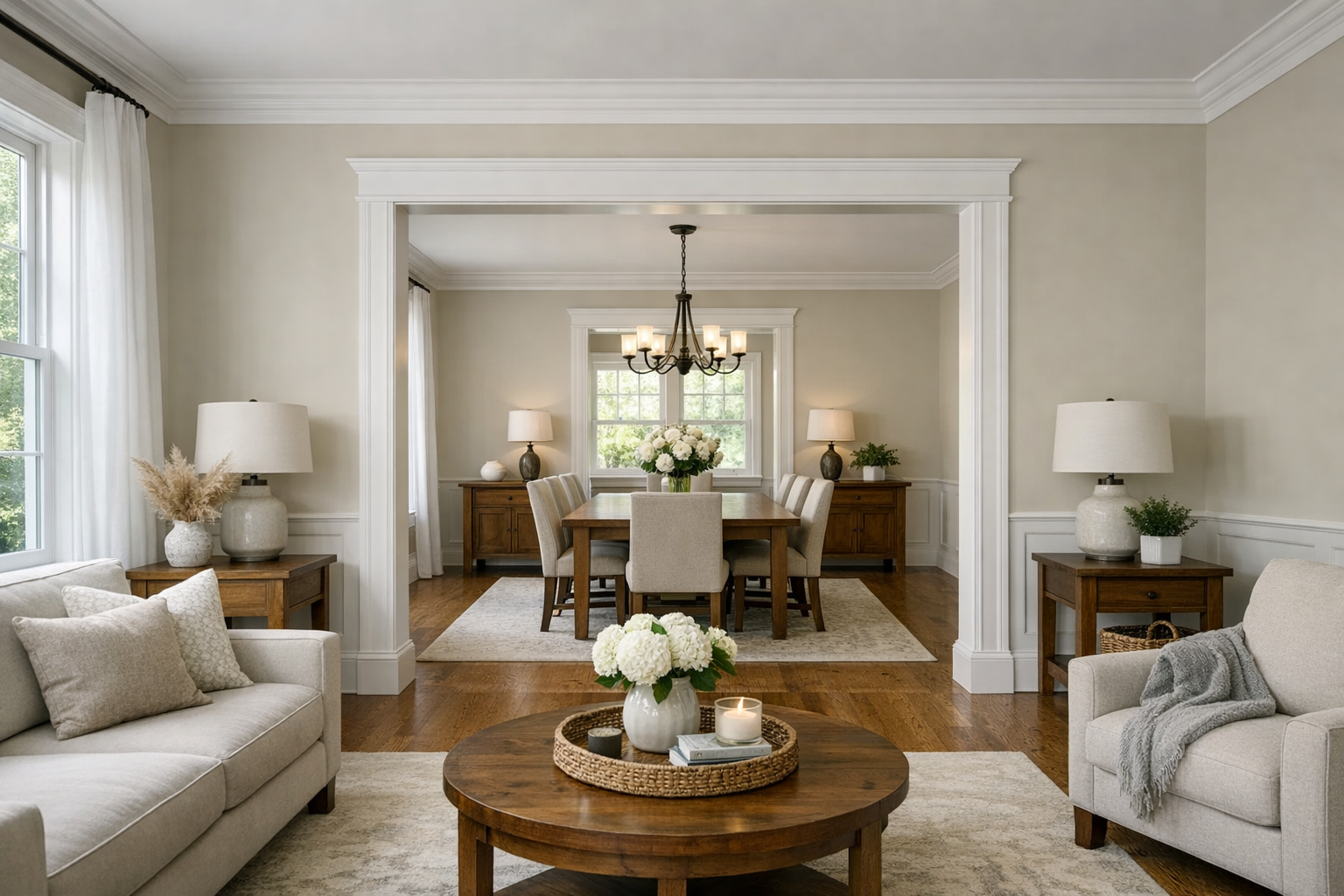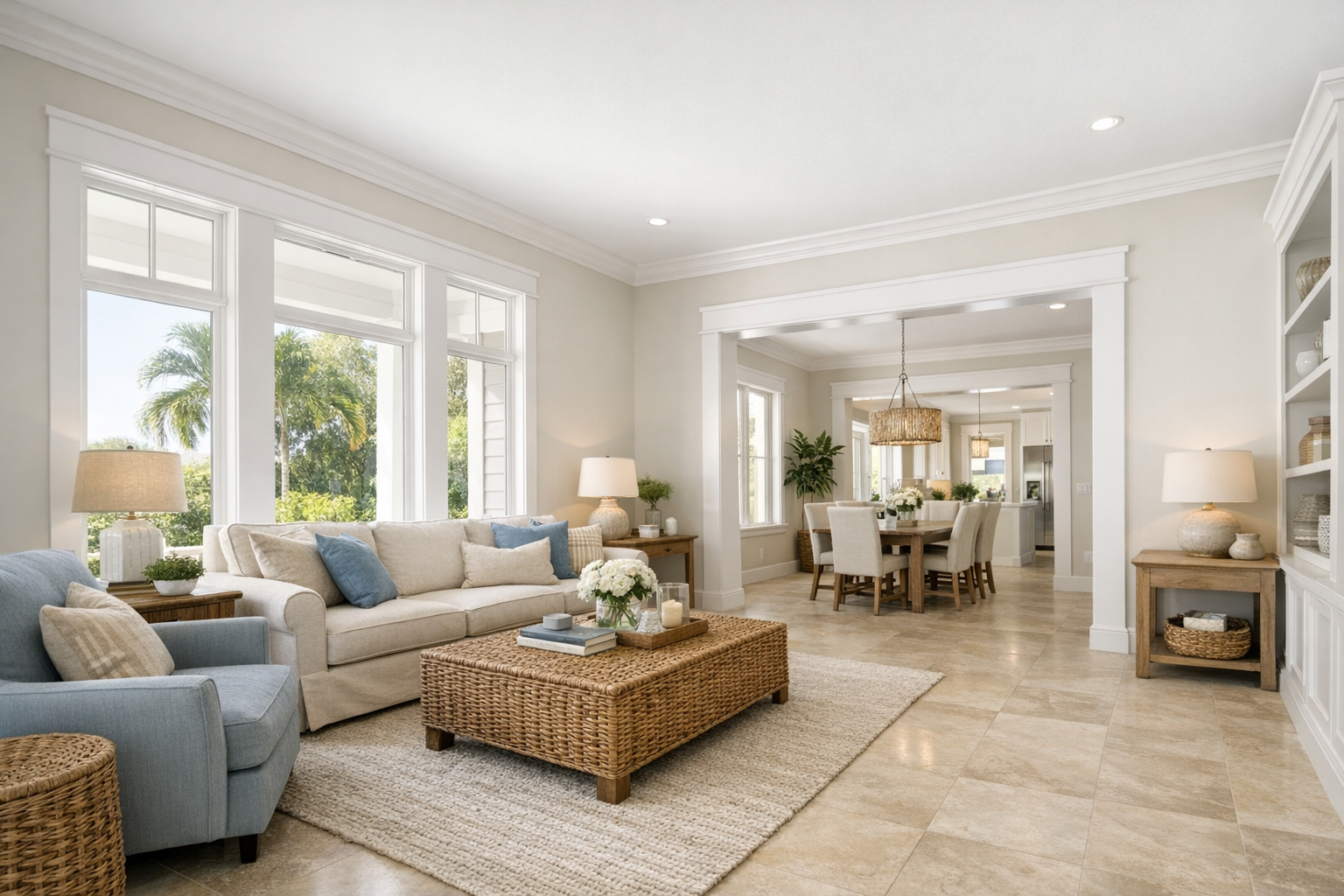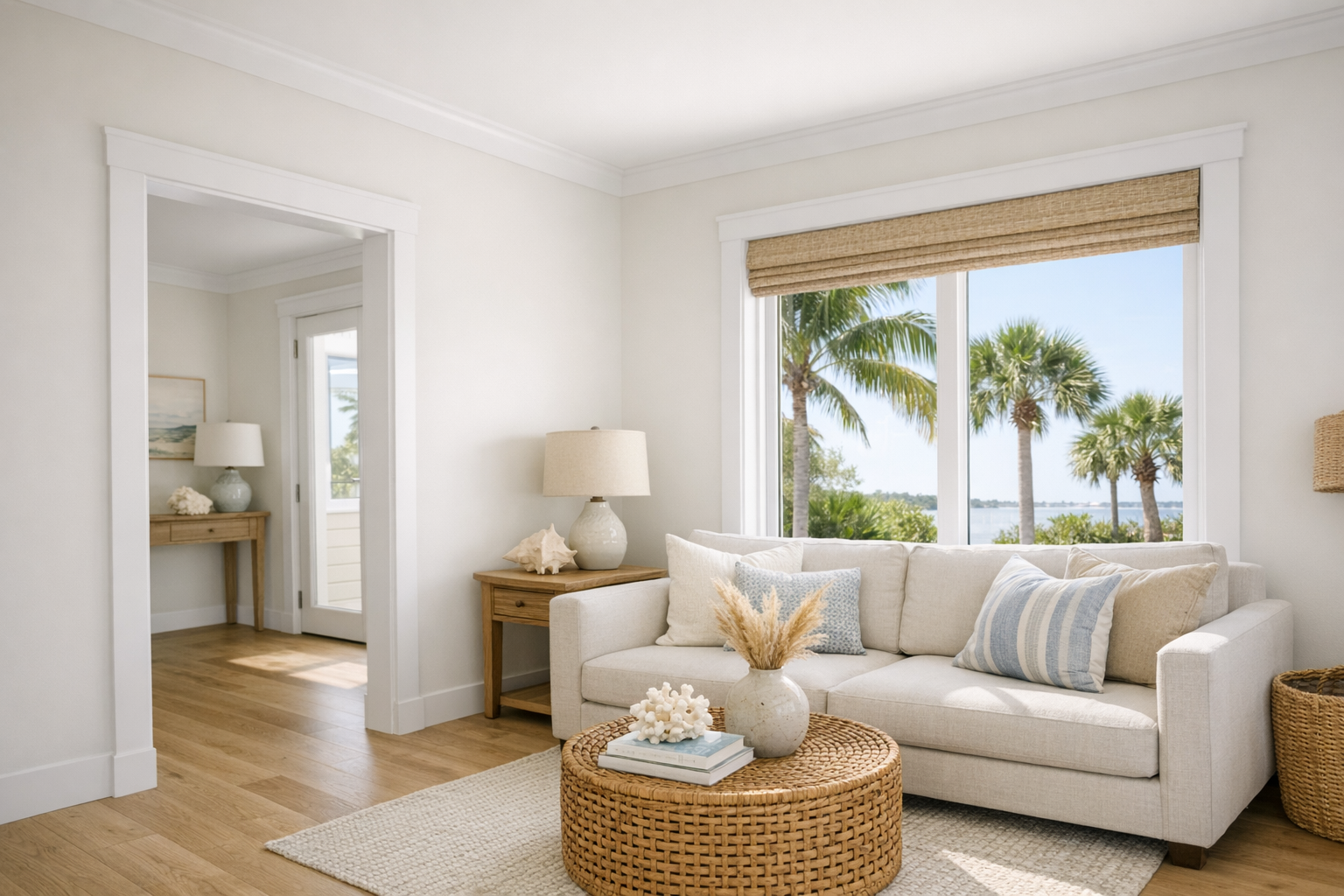
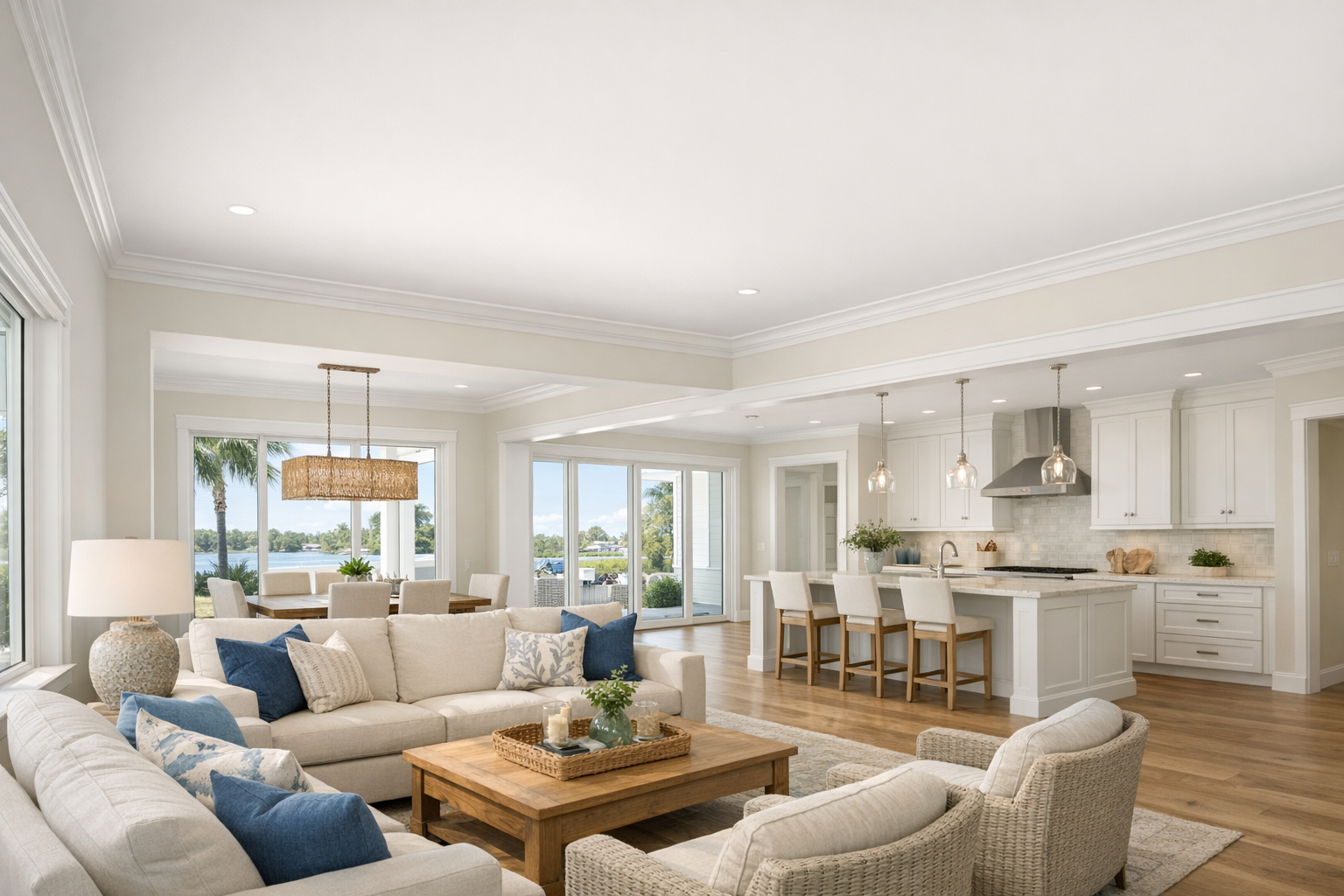

Crown moulding looks best when it is chosen for the ceiling first and the room second. In many Florida homes, bright natural light, pale walls, tall openings, and open sightlines make trim proportions more noticeable, so a profile that feels polished in one space can look thin, heavy, or out of place in another. The goal is not to pick the biggest or most decorative crown; it is to choose a size and shape that makes the ceiling transition feel intentional.
High ceilings usually need more visual weight than standard-height rooms because the wall-to-ceiling break sits farther above eye level. A small crown can disappear, while a taller or built-up profile can help the upper wall feel finished. A tray ceiling works differently: the crown can emphasize the stepped layers, frame the raised center, or support a lighting detail. In a coastal or transitional room, a cleaner profile often feels more current than a deeply ornate one.
Vaulted ceilings need the most restraint. Because the ceiling planes slope and change height, heavy traditional crown can look forced when it tries to follow every angle. A simpler profile, a level break, or a beam-adjacent trim detail often reads better than wrapping the entire slope. For homeowners considering crown moulding installation in Sarasota County, the smartest starting point is the ceiling shape: flat, tray, vaulted, or open-plan. Once that is clear, style choices become much easier.
Crown Moulding Ideas for High Flat Ceilings
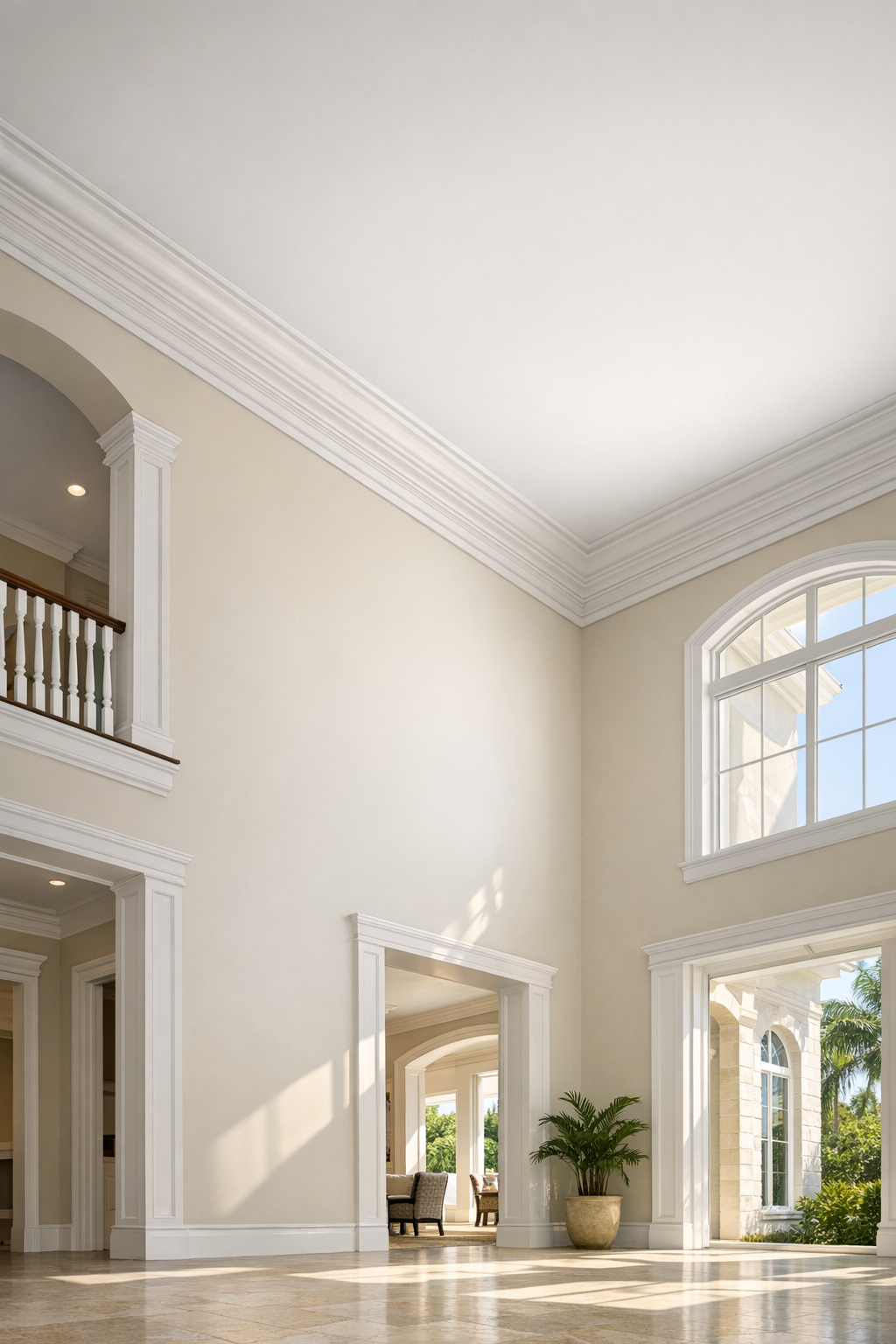
A flat ceiling gives you a clean horizontal line to work with, so the main design question is scale. In rooms with high ceilings, a narrow crown can look like a thin stripe at the top of a long wall, especially in a bright great room or two-story foyer. A taller profile, or a built-up profile with more vertical presence, helps the wall end with purpose instead of fading into the ceiling.
The easiest sizing logic is to look at the wall height, the length of the wall, and how far away people will view the trim. A primary bedroom with tall but contained walls may only need a clean, moderately tall crown. A large living room with long sightlines, tall sliders, and wide blank wall spans can usually carry more height and projection because the room has enough volume to make the moulding feel balanced.
Large decorative crown moulding works best when the room already has enough architectural detail to support it: substantial baseboards, taller door casing, built-ins, columns, or a more traditional interior style. It becomes weaker when it is the only ornate element in an otherwise simple coastal or modern room. In that setting, the eye notices the mismatch before it notices the craftsmanship.
Multi-piece crown is a good middle ground for many Florida homes because it builds presence without relying on one bulky, deeply carved profile. Instead of one heavy piece, the installer combines crown with a backer, frieze board, ceiling band, or smaller supporting trim to create a taller composition. The result can feel tailored and substantial while still staying clean enough for transitional or coastal interiors.
A strong choice for a high flat ceiling might be a crisp, layered crown that relates to the room's baseboards and cabinet trim. A weak choice would be a small stock profile that disappears from across the room, or oversized decorative crown that crowds the top of the wall and fights the home's simpler finishes. If you are comparing options for crown moulding installation Sarasota County homeowners often benefit from seeing profile samples held high on the wall, not just viewed at counter height, because scale changes dramatically once the trim is near the ceiling.
Tray Ceiling Crown Moulding: Framing Layers, Lighting, and Depth
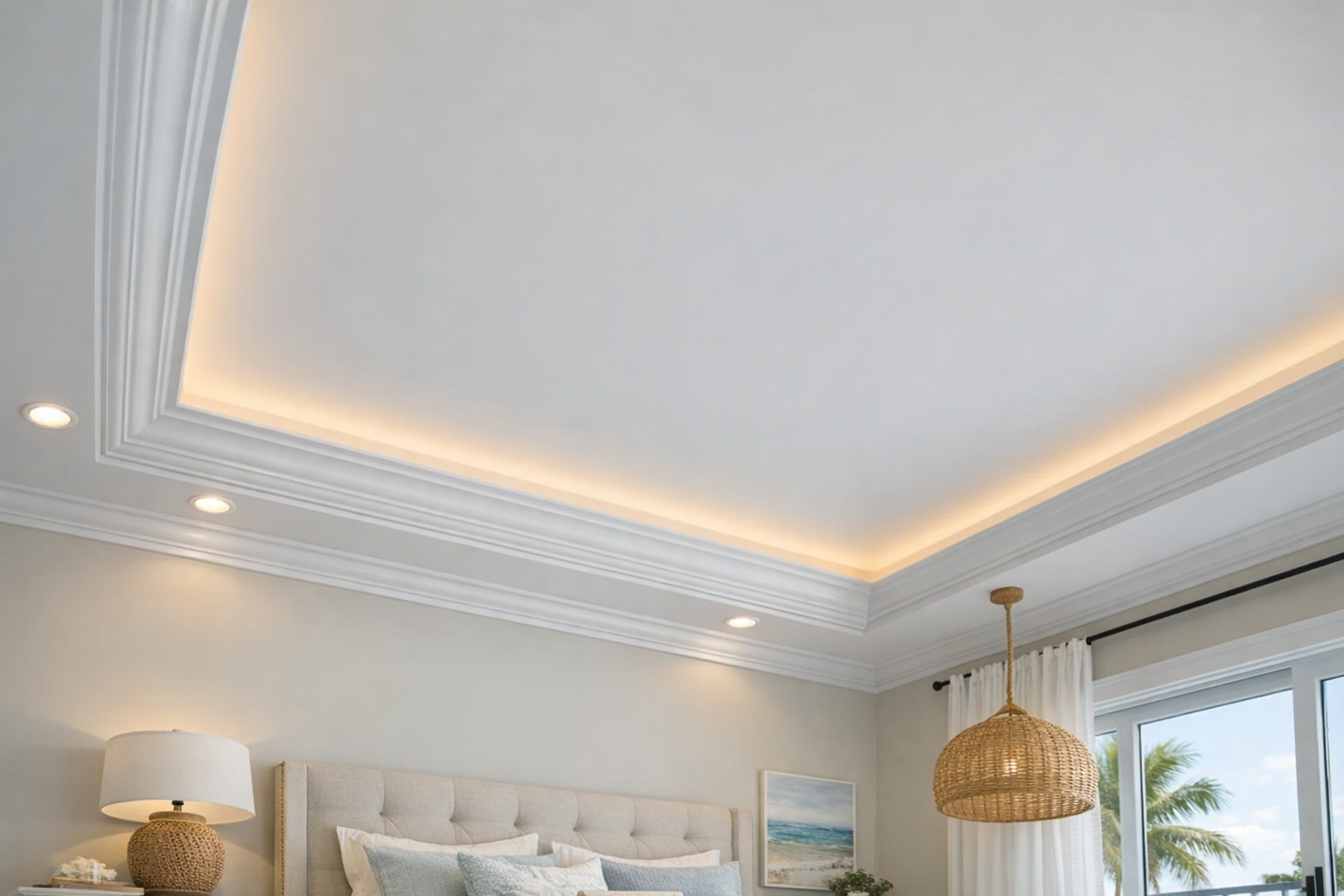
Tray ceilings give crown moulding more than one edge to work with, so the question is not just "how tall should the profile be?" but "which layer should the trim emphasize?" A single-step tray can look clean with crown around the lower perimeter, where the wall meets the dropped ceiling border. That outlines the room and makes the raised center feel intentional without loading the ceiling with too many lines.
A second option is to place tray ceiling crown moulding inside the raised center. This draws attention upward and works especially well in a primary bedroom, formal dining room, or foyer where the ceiling feature is meant to feel like a focal point. The practical difference is visual emphasis: perimeter crown frames the room, while inner crown frames the ceiling feature itself.
For a more layered look, a stepped crown uses multiple trim lines to echo the rise of the tray. This can be beautiful in a larger dining room or entry area because the trim reinforces the ceiling's depth. In a smaller bedroom, though, the same treatment can feel busy if every ledge gets its own profile. A good signal is whether the tray still feels airy after the trim is added; a weak signal is when the ceiling starts to look striped.
If the tray includes indirect LED or cove lighting, keep the crown profile clean enough that the glow remains the feature. A simple cove, small ogee, or squared transitional profile usually works better with soft lighting than a deeply carved traditional crown, which can cast heavy shadows. More decorative layered trim belongs in rooms with other formal details, such as paneled walls, substantial casing, or traditional furnishings; in bright coastal Florida interiors, simpler tray ceiling crown moulding often looks more current and relaxed.
Vaulted Ceiling Crown Moulding: When It Works and When It Looks Forced
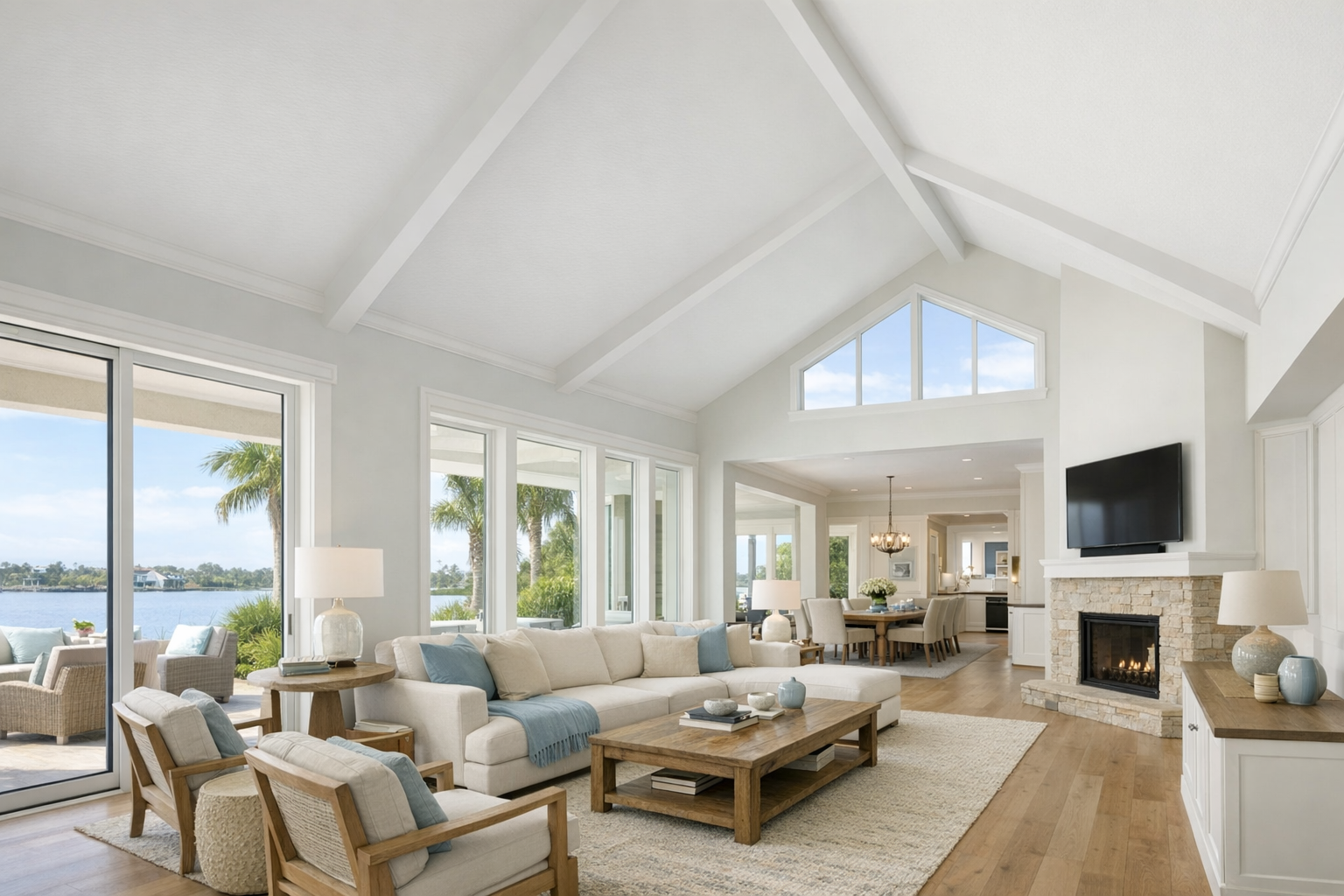
Vaulted rooms are less forgiving because the ceiling line is moving instead of staying level. Angled planes, changing wall heights, and long sightlines can make vaulted ceiling crown moulding look crooked even when the cuts are technically accurate. The issue is not just installation difficulty; it is whether the trim has a clear place to begin, end, and visually "belong."
The strongest use is usually along lower, level wall runs or at a defined architectural break. A level wall run is the portion of the room where the wall meets a flat ceiling edge before the slope begins; crown there gives the room a finished perimeter without chasing every roof angle. An architectural break might be a dropped beam, a flat soffit, or a transition where the vaulted area meets a kitchen, hallway, or dining zone. In those spots, the trim reads as intentional framing rather than a workaround.
A weak choice is heavy traditional crown wrapping up and down every sloped plane in a clean coastal great room. Large curves and deep shadow lines are designed to sit between two consistent surfaces; on vaulted ceilings, they can fight the roof pitch and draw attention to awkward miters. A simpler crown profile, such as a small cove, squared transitional trim, or flat frieze-like edge, usually respects the slope better because it adds definition without pretending the ceiling is flat.
Beams are another good alternative. Exposed beams define the slope itself, while beam-adjacent trim can sharpen the edge where a beam meets drywall. That approach works especially well when the room already has a tall central peak, because the eye follows the structure instead of hunting for a continuous crown line. In some vaulted spaces, no crown at all is the better design decision; smooth drywall edges, beams, or selective trim can look more deliberate than forcing a formal moulding pattern onto geometry that does not support it.
If you are considering crown moulding installation Sarasota County homes with vaulted ceilings, the key checkpoint is simple: does the crown create one clean visual path, or does it create a series of busy angled interruptions? If the answer is the second, simplify the profile, limit the crown to level sections, or let another ceiling feature do the work.
Modern Crown Moulding for Open-Plan Florida Living Areas
In a great room, the crown line often travels farther than any single wall, so it needs to feel like part of the home's trim language rather than a separate decoration for each zone. For open-plan living areas, that usually means choosing one main profile that can run from the kitchen to the dining area to the living space without calling attention to every corner or cabinet change.
Modern crown moulding does not have to be bare or boxy; it simply uses cleaner geometry and fewer carved details. A small cove softens the wall-to-ceiling transition, a squared stepped profile gives a crisp architectural edge, and a slim flat-stock build-up creates a subtle shadow line. The practical takeaway is that simpler profiles hold up better across long sightlines, especially in bright coastal or transitional design interiors where heavy ornament can feel busier than the room itself.
A strong open-plan choice might be a clean white crown that continues through the kitchen, breakfast area, and family room while relating to the cabinet crown, baseboards, and door casing. A weaker choice would be changing from ornate crown in the dining area to a tiny stock profile in the adjacent living room with no ceiling break between them; the eye reads that as a patchwork decision instead of intentional zoning.
Profile changes work best when the architecture gives you a reason. A tray ceiling over the dining table, a lower kitchen soffit, a beam line, or a shift from a flat ceiling to a taller great-room ceiling can justify a slightly different crown because the ceiling itself has changed. Without that kind of break, keep the crown consistent and let furniture, lighting, rugs, or ceiling details define the room functions.
For many Florida homes, modern crown moulding succeeds when it adds a clean finished edge without chopping the plan into pieces. If you can stand in the kitchen and look across the living area without the trim competing for attention, the profile is probably doing its job.
Choosing the Right Profile: Simple, Stepped, Decorative, or Built-Up
Profile is where the same room can shift from relaxed coastal to formal traditional. A simple moulding profile has fewer curves and smaller shadow lines: think a soft cove, a restrained ogee, or a squared transitional crown. In Florida rooms with white walls, large windows, and strong daylight, that restraint matters because every groove casts a visible shadow. The takeaway: simple does not mean unfinished; it means the ceiling edge stays clean instead of becoming the loudest detail in the room.

A stepped crown profile uses stacked, squared edges or layered reveals to create depth without heavy carving. It is especially useful on tray ceilings because the profile can echo the ceiling's layers, and it also works well in high flat rooms where a single small crown would feel too thin. Compared with a simple cove, stepped crown feels more architectural and structured; compared with ornate crown, it usually feels lighter and more current.
Large decorative crown moulding has deeper curves, more projection, and sometimes traditional details that draw the eye upward. It can look beautiful in a tall dining room, foyer, or formal living area where the baseboards, door casing, cabinetry, and ceiling height are substantial enough to support it. A weak use would be placing large decorative crown moulding in a minimalist vaulted great room with pale walls and little other trim detail, where the crown may feel heavier than the architecture around it.
Built-up crown is assembled from multiple pieces, often combining crown with flat stock or smaller trim to create a taller custom look. This is a smart option when the room needs more scale but not more ornament, such as a high-ceiling great room with taller baseboards and clean cabinetry. For vaulted ceilings, keep built-up details limited to level runs or clear architectural breaks; once the profile has to chase several changing angles, the extra layers can make the geometry look busy rather than refined.
If you are comparing samples before crown moulding installation Sarasota County homes with bright, open layouts, view the crown from across the room, not just up close. The best choice usually relates to the ceiling height, carries enough presence for the wall span, and still feels compatible with the home's coastal, transitional, or modern style.
How Crown Should Coordinate With Baseboards, Door Casing, Cabinets, and Ceiling Features
The trim at the floor and around openings sets the "visual weight" that the crown has to answer. Taller baseboards can support a taller or built-up crown; slim baseboards and narrow door casing usually call for a cleaner, lighter crown. The pieces do not need the same exact profile, but they should share a language: squared with squared, softly curved with softly curved, formal with formal.
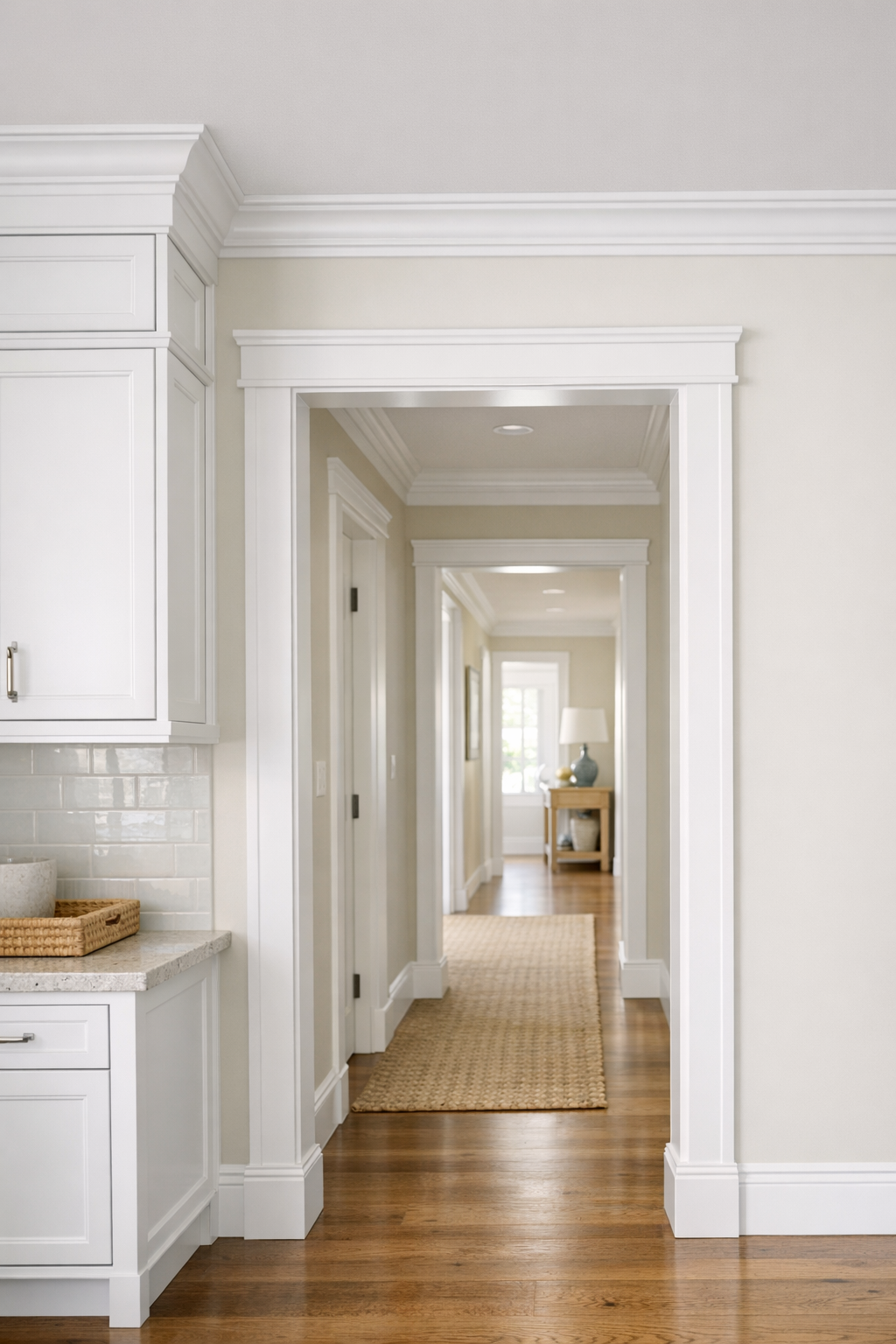
Kitchen cabinet crown is another checkpoint in open layouts. If the cabinet crown is prominent, the room crown can either echo its shape in a slightly larger scale or stay simpler so the kitchen does not feel over-trimmed. Around a coffered ceiling, beams, or custom ceiling trim, crown should clarify the ceiling feature rather than compete with it; on vaulted or angled areas, beam-adjacent trim or level crown runs usually look cleaner than forcing ornate crown through every slope.
Finish ties everything together. White crown with white casing creates a crisp coastal look, off-white softens the contrast, and wall-colored crown can make a modern room feel less segmented. At the wall-to-ceiling transition, the best signal is simple: the crown should look like the natural ending of the wall, not a separate strip added after the room was finished.
Planning Crown Moulding Installation in Sarasota County or Venice, FL
When you are ready to price the work, treat the first conversation as a design check, not just a linear-foot estimate. Ceiling height, wall length, cabinet breaks, tray dimensions, and existing trim all affect whether a profile reads balanced or undersized. For a high flat ceiling, compare a single taller crown with a built-up version; the built-up option adds more presence, while a simpler one keeps a coastal or modern room calmer.
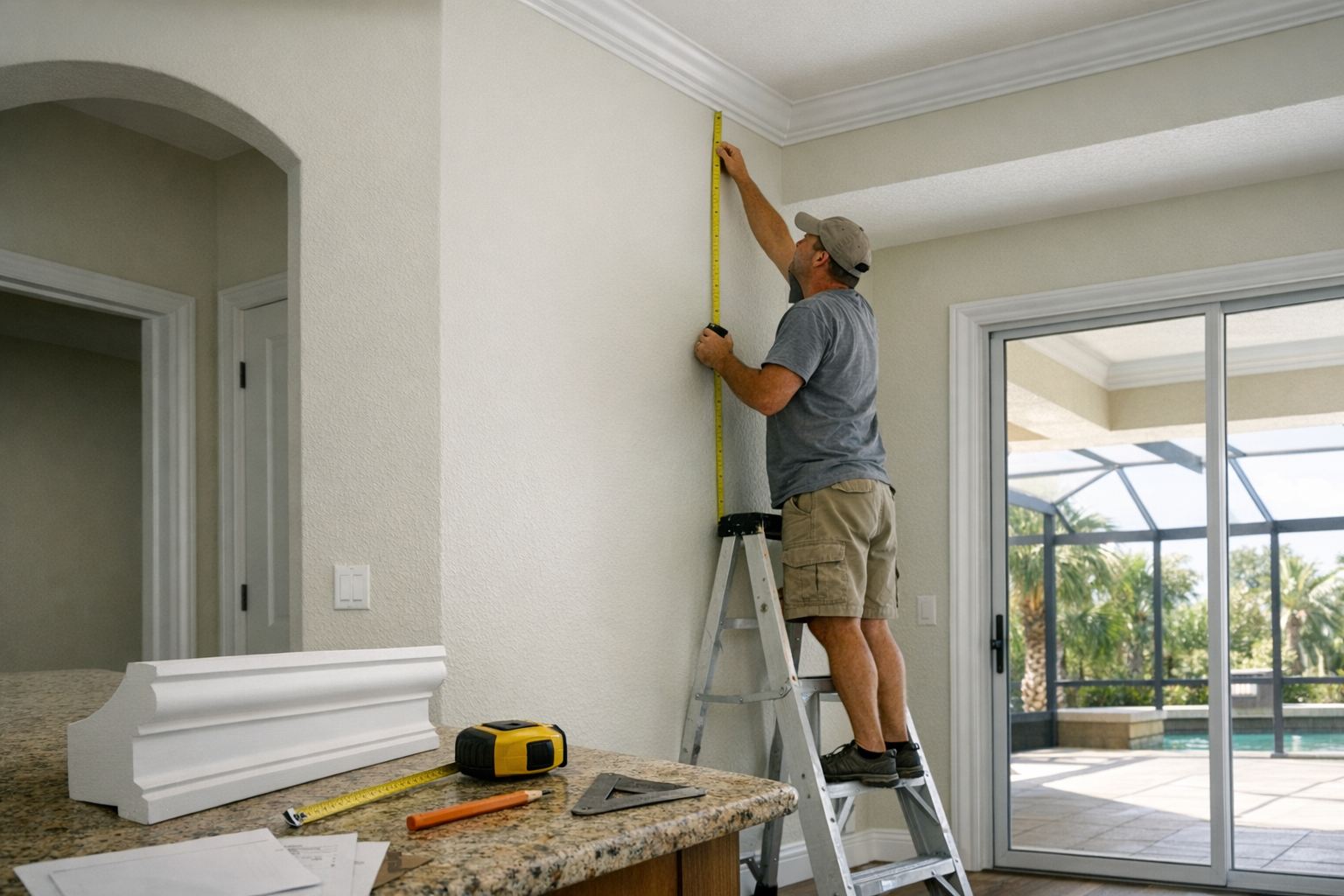
Tray ceilings need especially clear measuring because the lower perimeter, raised center, and any lighting pocket may call for different trim depths. A useful sample test is to hold the profile where it will actually sit, then view it from the room entrance and from the main seating area. If the sample looks graceful up close but busy across the room, it may be too detailed for the tray.
Vaulted ceilings deserve a separate layout discussion before crown moulding installation in Sarasota County or Venice homes. The key decision is where the crown should stop, turn, or give way to a cleaner trim detail. Level runs, architectural breaks, and simplified profiles usually look more intentional than forcing heavy crown through every sloped plane.
For custom ceiling trim, bring photos of the room, cabinet crown, baseboards, and ceiling features, then compare real profile samples before choosing a finish. A crown moulding installer Sarasota County homeowners consider should be comfortable talking through scale, sightlines, profile depth, and paint planning so the finished trim looks designed for the home rather than added as an afterthought.
Choosing Crown Moulding That Looks Intentional
The final test is whether the trim feels inevitable from the doorway. On a high flat ceiling, that usually means enough vertical presence to finish the long wall; a tiny stock crown can vanish, while large decorative crown moulding only works when the room has the baseboards, casing, cabinetry, or traditional detail to support it. In a bright coastal room, the smarter upgrade may be a taller clean profile rather than more carving.
Tray and vaulted ceilings ask for different kinds of control. A tray ceiling benefits from choosing the layer you want to feature: the lower perimeter for a crisp room outline, the raised center for emphasis, or a stepped treatment for more depth. A vaulted ceiling usually needs restraint because sloped planes can make heavy crown look awkward; level runs, architectural breaks, or simpler profiles keep the line from feeling forced.
For open-plan homes, crown should relate to nearby baseboards, door casing, cabinet crown, beams, and ceiling details without copying every profile exactly. The practical takeaway for homeowners comparing crown moulding in Venice, FL, or planning crown moulding installation in Sarasota County is to decide the design and installation approach together: profile size, stopping points, room transitions, finish, and site conditions should be planned as one composition, not chosen one piece at a time.