
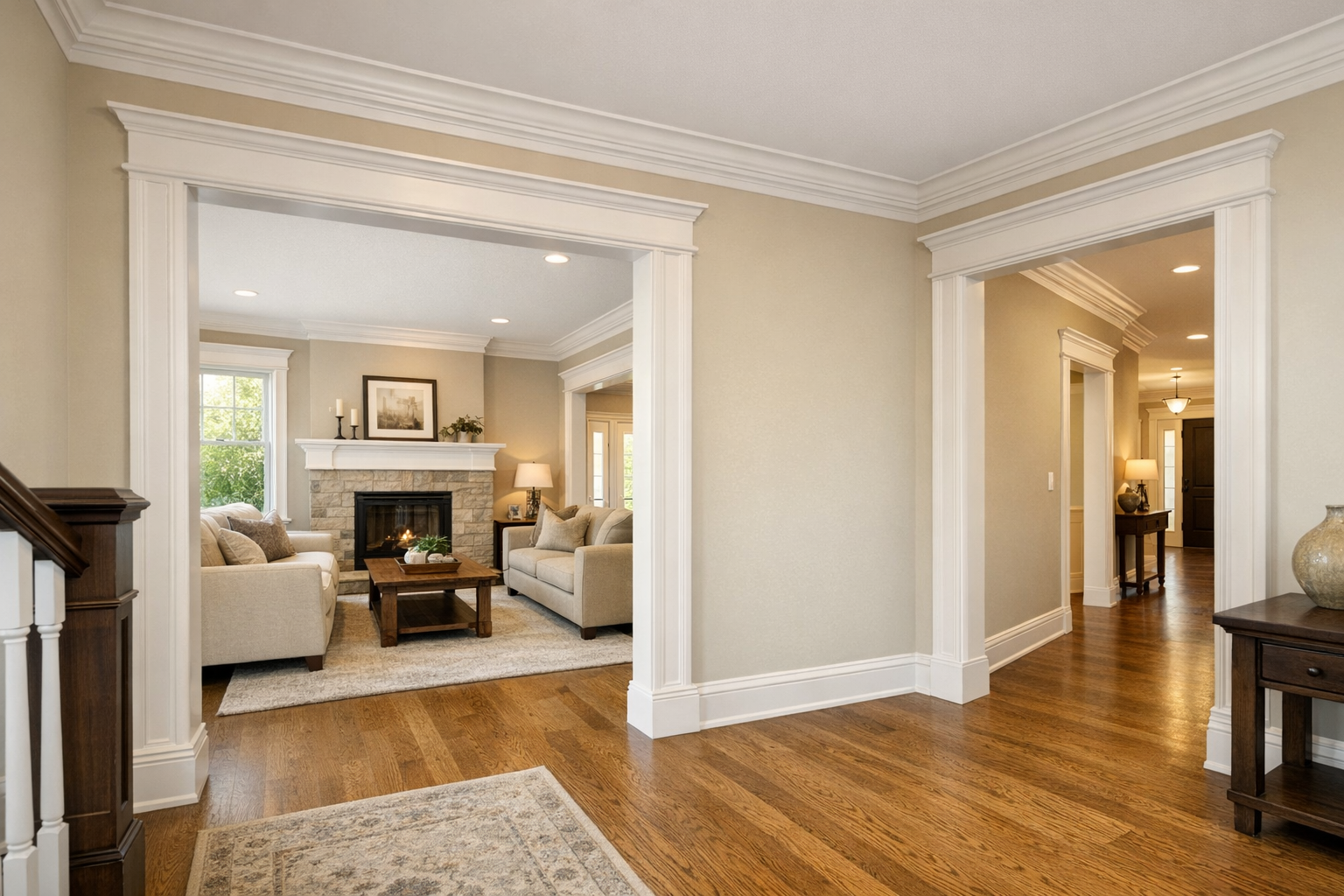
Start with the trim pieces that repeat everywhere: baseboards, door casing, window casing, and the transitions between rooms. When those profiles are selected together, planning, material selection, supply, and interior trim installation can follow one coordinated scope instead of a series of separate room decisions.
A well-planned whole house trim package typically coordinates the major visible details: baseboards, door and window casing, crown molding, shoe molding, wall trim, and specialty accents where they make sense. The practical goal is simple: the living room, hallways, bedrooms, and main gathering spaces should feel related, even when certain rooms need a more detailed or more durable trim treatment.
That coordination matters because piecemeal trim choices can create small conflicts that become obvious once everything is painted or stained. A tall baseboard paired with undersized casing, a formal crown profile in one room and a completely different style next door, or missed transitions at openings can make the finish feel patched together. A package approach sets the main trim language first, then adjusts room by room with intention.
Your package can also be shaped around budget and finish level. Paint-grade trim often uses materials such as MDF, finger-jointed pine, or poplar for a clean painted result, while stain-grade work puts more emphasis on visible wood grain and species selection. The takeaway: the right package balances appearance, durability, finish expectations, and cost before materials are ordered or cuts are made.
What a Whole-Home Trim Package Can Include
In practical terms, a whole-home interior trim package is the written scope for the trim details being selected, supplied, and/or installed across the house. It can be as simple as a consistent set of baseboards and casing, or it can grow into a complete home trim package with ceiling, wall, and specialty details included room by room.
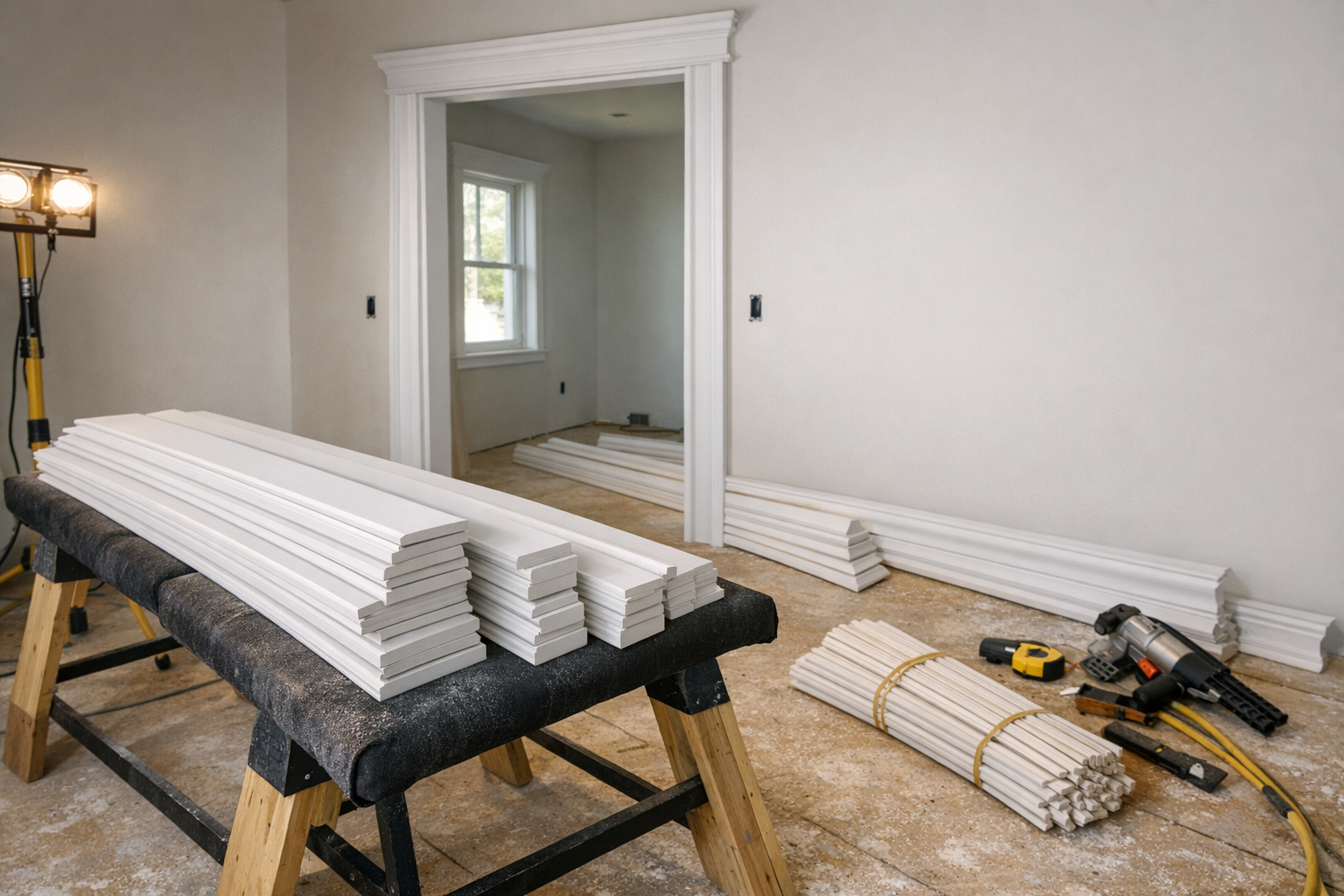
- Baseboards run along the bottom of the walls and help finish the transition from wall to floor. Taller or more detailed baseboards create a stronger visual line, while simpler profiles keep the look cleaner and more understated.
- Door casing and window casing frame openings. These profiles are especially important because they repeat throughout the home, so their width, shape, and reveal lines affect how polished each doorway and window feels.
- Crown molding finishes the wall-to-ceiling transition. It may be used throughout the main level, limited to formal rooms, or skipped in rooms where a simpler ceiling line fits better.
- Shoe molding or quarter round are smaller floor-level pieces used with baseboards where the floor meets the wall. They can help cover small gaps while adding another finished edge.
- Chair rail, panel molding, and wainscoting are wall trim options. Chair rail creates a horizontal break, panel molding adds framed wall shapes, and wainscoting builds a more substantial lower-wall treatment.
The service scope can also include design guidance, material selection, product supply, installation, and finishing coordination. Some projects need only profile recommendations and a material takeoff; others need the full sequence handled from measurements through finish-ready installation. The main takeaway is to define what is included before ordering begins, so the trim list, room list, material choice, and finish expectations are all working from the same plan.
Why Planning Trim as a Full Package Works Better
The trouble usually shows up at the connections: a hallway casing runs into a taller baseboard, a formal room crown feels heavier than nearby openings, or two "close enough" profiles meet in the same sightline. Setting those decisions before ordering helps standardize the major elements, profile shape, height, width, species, and finish level, so each room can have its own emphasis without looking unrelated.
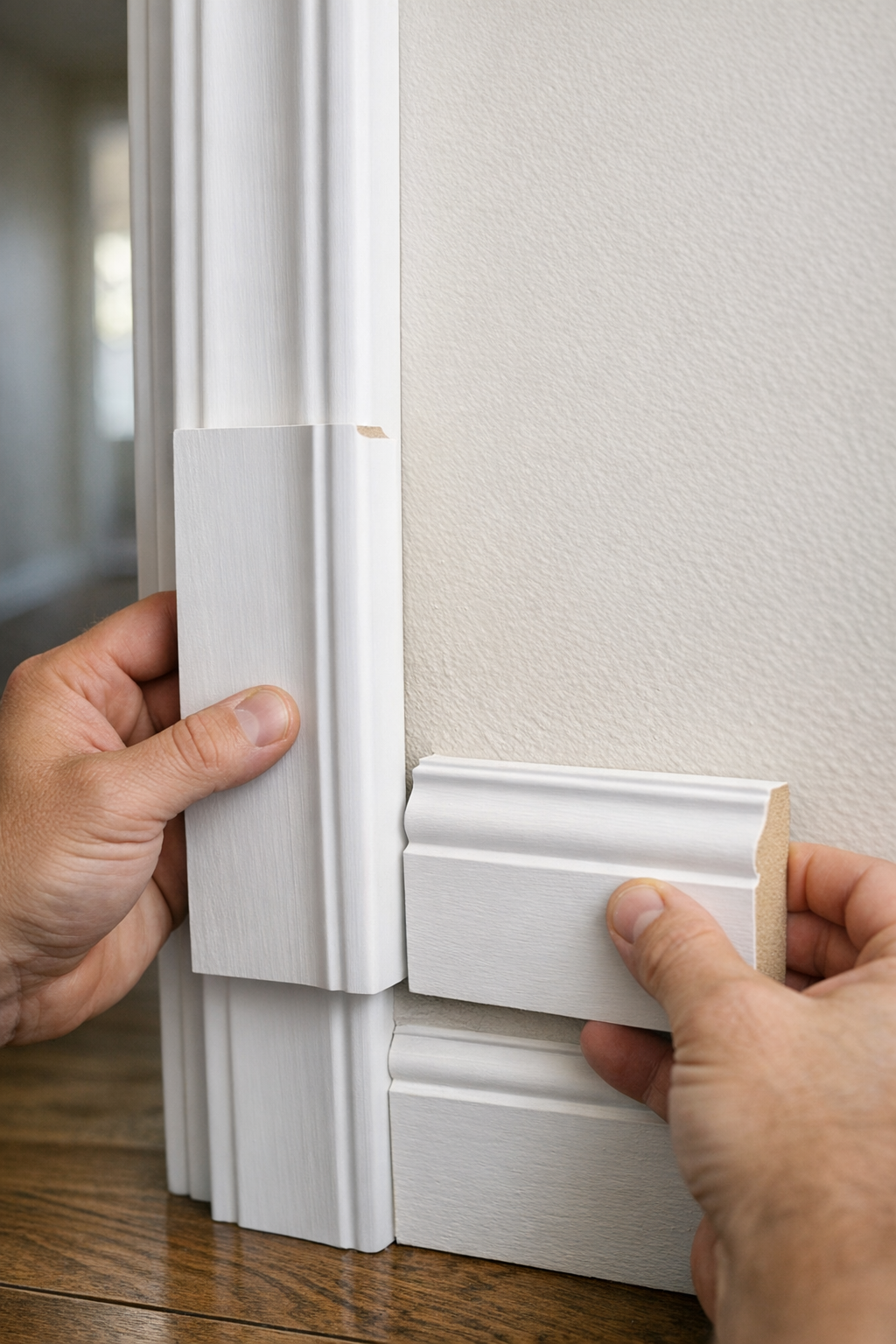
A strong trim plan also sets the right scale before material is ordered. Baseboards can be sized to the ceiling height, casing can be wide enough to frame doors and windows properly, and reveal lines, the small, even setbacks where casing meets the jamb, can stay consistent from opening to opening. Weak signals are easy to spot: undersized casing beside tall doors, mixed colonial and square-edge profiles in adjacent rooms, or reveals that change because each room was trimmed as a separate decision.
The practical side matters just as much as the look. When the package identifies trim sizes, profiles, species, and finish level early, the material list can be built around the full house instead of patched together room by room. That makes it easier to group matching stock, plan which rooms need specialty details, and avoid ordering one style for the first floor and a slightly different one later because the original choice was not carried through.
Installation sequencing is clearer, too. Door and window casing, baseboards, crown, and wall trim all affect one another at corners, openings, stair areas, and transitions between rooms. A well-built package gives the installer a consistent roadmap; a weak plan leaves too many decisions to be solved on site, where small mismatches can become permanent visual distractions.
Customized by Home Style, Room Type, and Finish Level
From there, the design work becomes more selective: the same home can keep a consistent trim language while changing the emphasis from room to room. A custom trim package for a modern interior may use flatter baseboards, square-edge casing, and minimal crown. A traditional home may call for more shaped profiles, built-up crown, and richer door and window casing. Craftsman trim often leans on wider, simpler boards and strong horizontal lines, while transitional or farmhouse interiors usually work best when the profiles are clean but not plain.
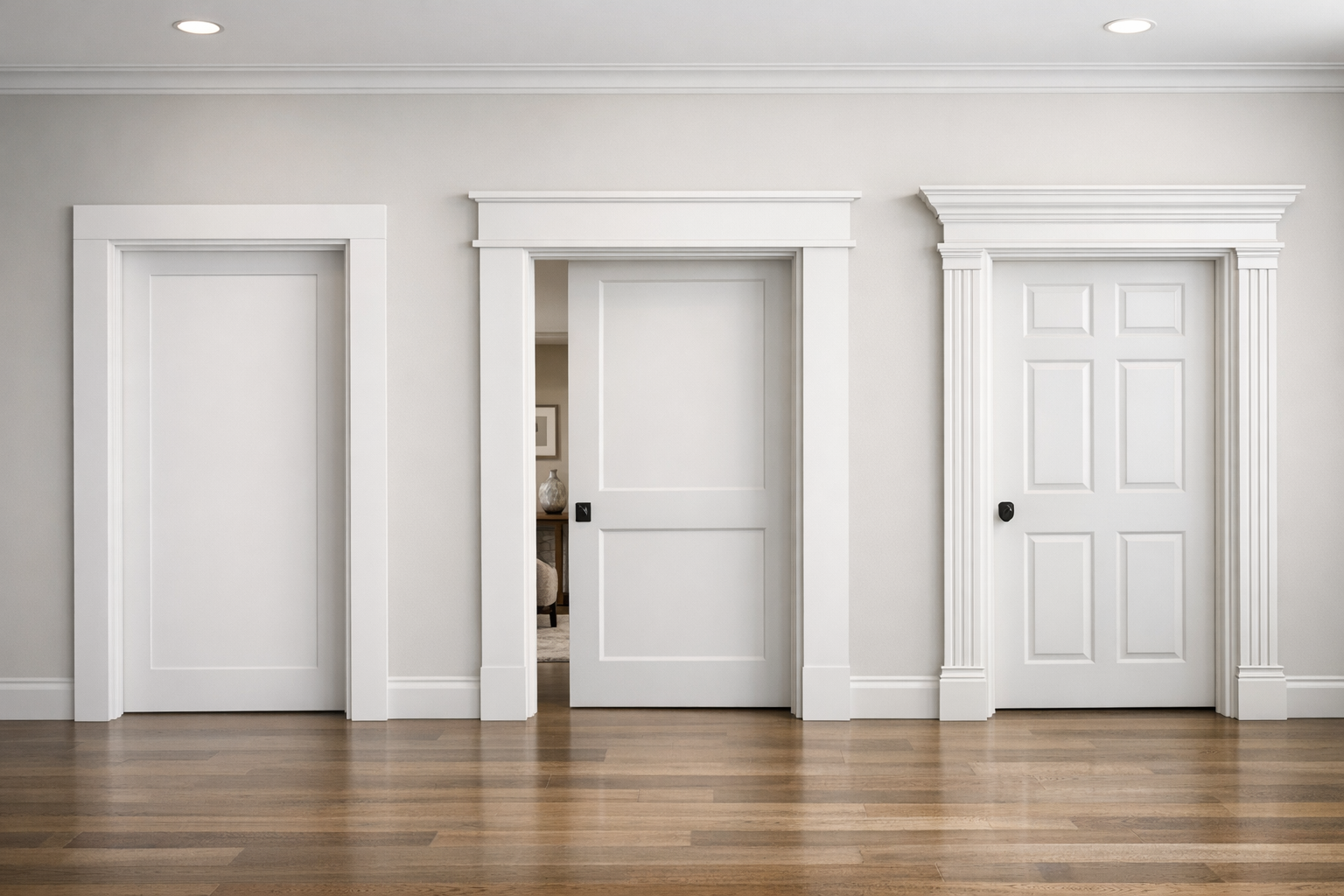
Room type matters just as much as architectural style. Secondary bedrooms may only need well-scaled baseboards and casing, while a dining room, entry, office, or primary suite might justify crown molding, panel molding, custom millwork, or a chair rail to give the space more presence. The key distinction is purpose: everyday rooms benefit from restraint and durability, while formal or feature rooms can carry more detail without making the entire house feel overdone.
Finish level also changes the package. Paint-grade trim is often selected for a smooth, uniform painted result, with common options such as MDF, finger-jointed pine, or poplar. Stain-grade work puts more attention on visible grain, wood species, and color consistency. In baths, laundry rooms, and other moisture-prone spaces, material and finish choices deserve extra attention because they affect appearance, durability, cost, and the final finish result.
Proportion is the checkpoint that keeps customization from turning into clutter. Taller ceilings can usually carry taller baseboards, wider casing, or deeper crown, while lower ceilings often look cleaner with slimmer profiles and fewer layers. A good plan lets the important rooms step up in detail while keeping the surrounding trim related, so the finished home feels intentional rather than pieced together.
Trim Materials and Finish Choices
Material is where the look, finish, and budget start to separate. For painted trim, MDF is often used when the goal is a smooth, uniform surface with crisp profile lines. Finger-jointed pine is another common paint-grade choice, giving the installer real wood lengths while still being intended for paint rather than visible grain. Poplar can also fit painted packages when a wood substrate is preferred.

Stained trim is a different conversation. Because the finish stays transparent, the species, grain pattern, color variation, and joinery become part of the final appearance. Oak, maple, cherry, walnut, or other solid wood species can all create a different feel, but the practical takeaway is consistency: stained casing, baseboards, doors, stair parts, and specialty millwork need to be selected so they look related once finished.
Durability and room use also affect the recommendation. High-traffic areas need trim materials and finishes that can handle scuffs, cleaning, and daily contact, while moisture-prone rooms call for more care in material and finish selection because those choices influence long-term appearance and performance. A good package does not choose one material everywhere by habit; it matches the material to the finish goal and the room conditions.
Specialty millwork, such as built-up crown, wall paneling, custom headers, or feature-room details, may use a different material than the standard base and casing if the profile, scale, or finish calls for it. In whole-home trim packages, the important part is not making every piece identical; it is making the material choices intentional so painted areas finish cleanly, stained areas show the right wood character, and upgraded rooms still connect to the rest of the home.
Packages for New Construction, Remodels, and Partial Matching
Project type changes how the trim plan is built. A new construction trim package is usually the cleanest starting point because the profile sizes, species, and finish level can be selected before the interior openings, doors, windows, crown details, and baseboards are installed. That gives the home one planned trim language from the first room to the last.

Whole-home renovations use the same coordinated approach, but the package has to respond to what is already in the house. Existing casing widths, base heights, reveal lines, plinth blocks, rosettes, crown details, and specialty profiles may need to be measured before deciding what stays, what gets replaced, and what should be simplified for a cleaner result.
Additions and partial remodels are where matching matters most. If a new primary suite connects to an older hallway, or a kitchen remodel opens into an existing dining room, the package should identify the transition points in advance. Sometimes the best choice is a close profile match; other times, a deliberate break at a cased opening, archway, or room change looks more intentional than a near-match that is visibly off.
A strong partial-matching plan starts with field measurements, profile comparison, and a clear room-by-room scope. A weak plan relies on a photo, orders something "close enough," and leaves the installer to solve mismatched heights or shapes on site. Whole-home trim packages help avoid that by treating new work and existing details as one connected finish plan.
What Affects the Quote and Timeline
A trim installation quote is usually shaped by three buckets: how much trim is being installed, what profiles and materials are selected, and how ready the house is for the work. Home size, number of rooms, door and window count, and linear footage affect the takeoff because baseboards, casing, crown, shoe molding, and wall trim are measured and ordered by scope rather than guessed as a flat allowance.
Profile complexity also matters. A simple one-piece baseboard installs differently than a taller built-up base with cap molding; standard door casing is different from layered headers, plinth blocks, or detailed window surrounds. Ceiling height can change the recommendation, too, because taller rooms may call for larger crown or wider casing, while lower rooms often work better with cleaner, slimmer profiles.
Material and finish level are another major part of the estimate. Paint-grade choices such as MDF, finger-jointed pine, or poplar are typically evaluated differently than stain-grade wood, where grain, species, and visible color consistency become part of the selection. A finish-ready installation with tight miters, clean reveals, filled nail holes, and painting coordination requires a different level of planning than a basic install-only scope.
Removal and site conditions can affect both cost and schedule. Existing trim demolition, uneven walls, flooring transitions, occupied rooms, furniture protection, and access to stairways or tall ceilings all influence how quickly the work can move. Painting coordination matters as well: some projects run smoother when trim is pre-primed or painted after installation, while others need sequencing around painters, flooring, cabinets, or final punch work.
For a more accurate estimate on whole-home trim packages, the most helpful information is a floor plan if available, a room-by-room list of desired trim, ceiling heights, door and window counts, photos of existing trim, preferred material or finish, and whether old trim needs to be removed. The clearer the scope is up front, the easier it is to prepare a trim installation quote that reflects the actual home instead of a rough placeholder.
Start With a Trim Package Consultation
You do not need every profile, material, or room detail chosen before reaching out. The consultation is where those choices get organized: we can review plans, walk through rooms, compare existing trim, discuss paint-grade or stain-grade goals, and narrow the package into baseboards, casing, crown, wall trim, specialty details, supply, installation, or a combination of services.

From there, the next steps are straightforward: confirm the room-by-room scope, recommend profiles and materials that fit the home, prepare a custom trim package quote, schedule the work, coordinate material supply, and complete the installation. If you are planning a build, remodel, or full-home trim refresh, request a consultation and we'll help turn the trim ideas into a clear, workable plan.
FAQs
Can a trim package be customized for different rooms?
Yes, a trim package can keep one consistent style while adding more detail in rooms like dining rooms, entries, offices, and primary suites. Secondary bedrooms may only need baseboards and casing, while feature rooms can include crown molding, panel molding, custom millwork, or chair rail.
What trim materials are best for painted trim?
Painted trim commonly uses MDF, finger-jointed pine, or poplar. MDF provides a smooth, uniform painted surface, finger-jointed pine offers real wood lengths intended for paint, and poplar works when a wood substrate is preferred.
What affects the cost of a whole-home trim package?
Cost is affected by home size, number of rooms, door and window count, linear footage, trim profiles, material choice, finish level, and site conditions. Existing trim removal, uneven walls, flooring transitions, stair access, tall ceilings, and painting coordination can also change the quote and timeline.
Is a whole-house trim package better for new construction or remodeling?
A whole-house trim package works for both, but new construction is the cleanest starting point because profiles, species, and finish level can be chosen before installation begins. Remodels and additions benefit from the same coordinated plan, but existing casing widths, base heights, reveal lines, crown details, and transition points must be measured first.