
Choosing the best trim materials for Florida homes starts with one question: where will the trim live? A baseboard in a dry, air-conditioned bedroom has a very different job from casing beside a shower, trim in a laundry room, boards near a concrete slab, or exterior window trim facing rain, sun, and salt air.
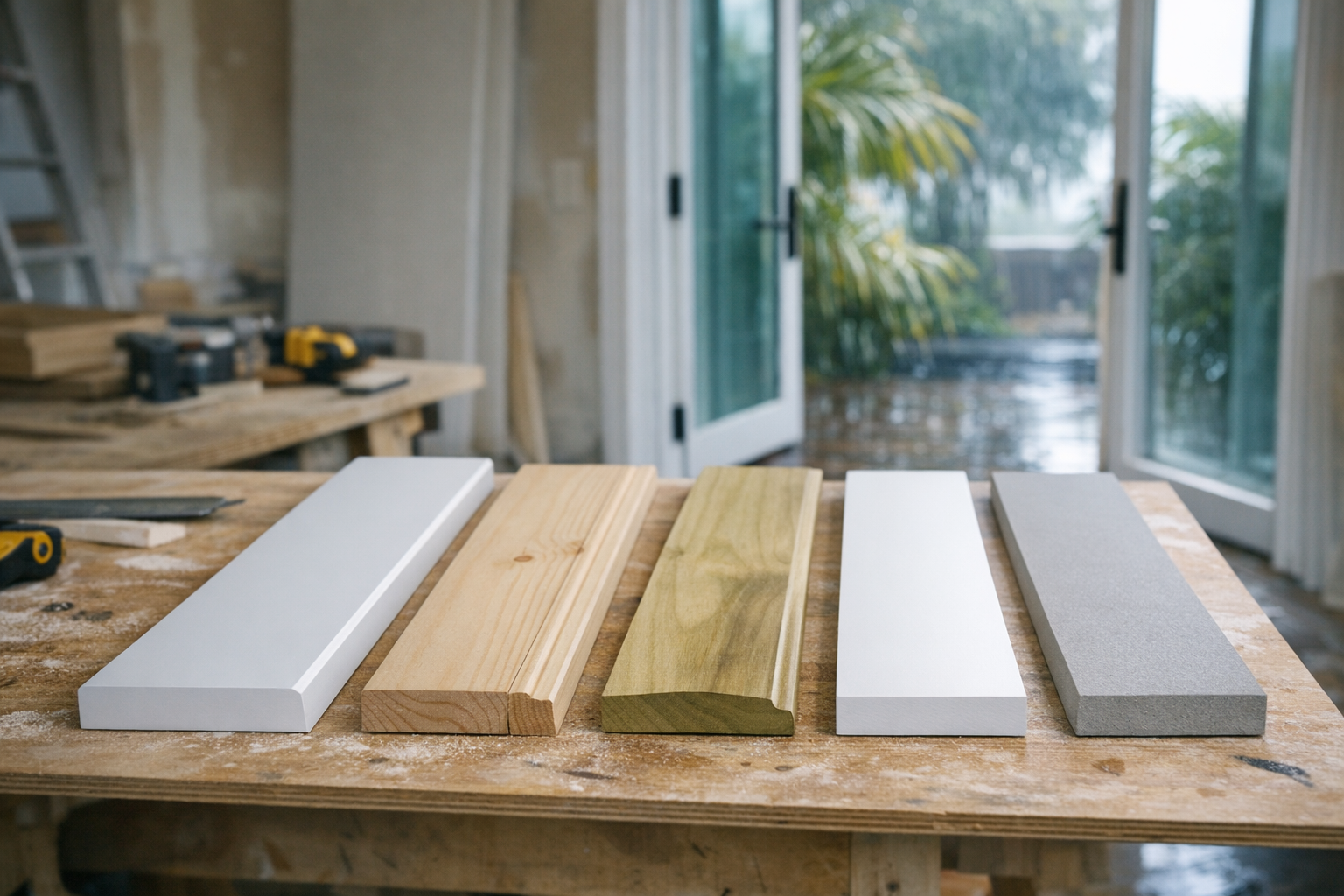
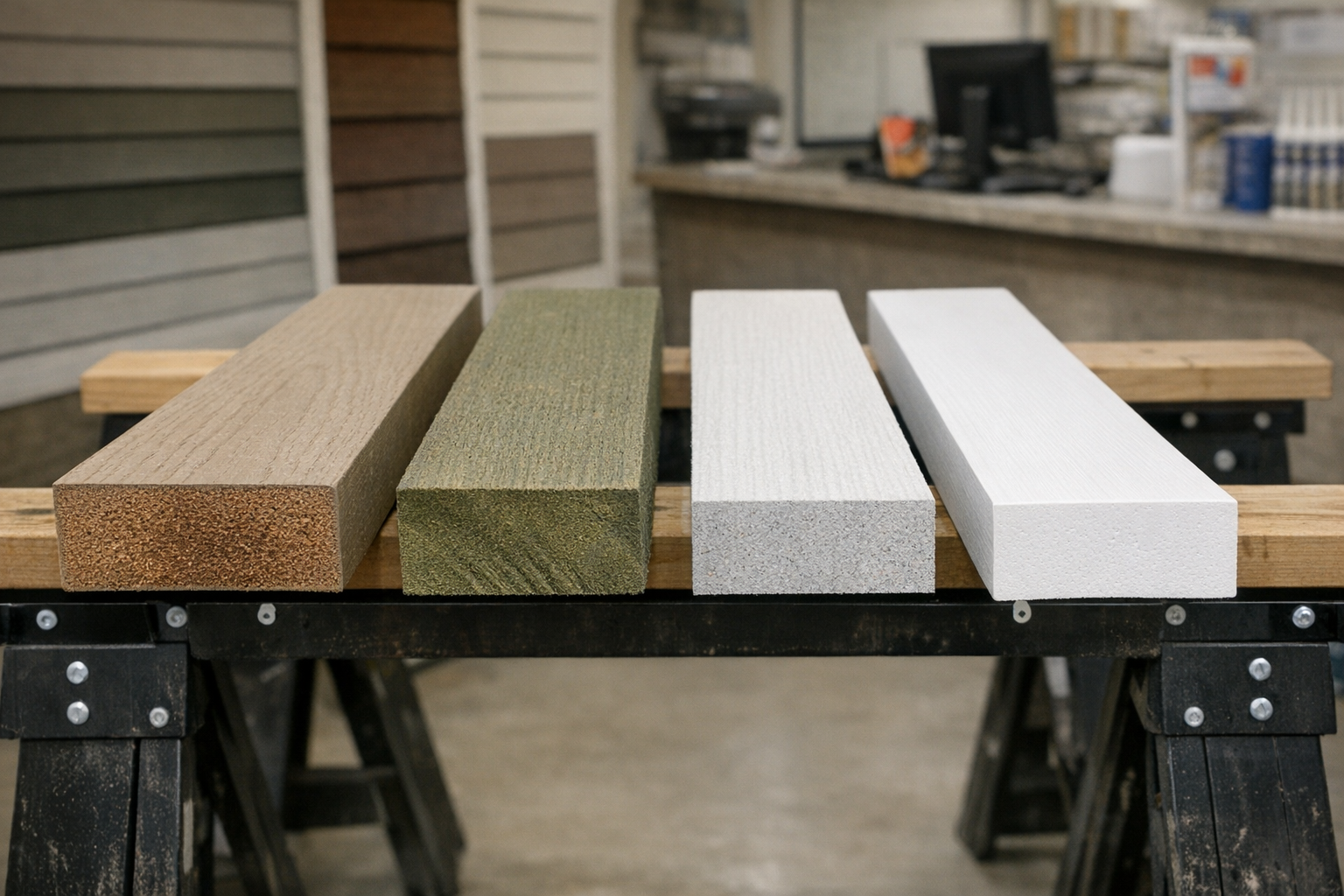
That is why this comparison is not about crowning one universal winner. MDF is a smooth, paint-grade material that can make sense for dry interior baseboards, casing, crown molding, and wainscoting. Wood trim covers several choices, finger-jointed pine, poplar, and solid wood, and each brings a different mix of paint quality, strength, movement, cost, and appearance. PVC trim is a moisture-resistant plastic option often considered for wet rooms and exterior trim boards. Composite trim is the broad middle category, with performance that depends heavily on the product's ingredients and intended exposure.
The practical takeaway is simple: match the trim to the exposure level first, then weigh finish, budget, durability, and maintenance. The best trim for humid climates is not always the most expensive material; it is the one whose weaknesses are least likely to show up in that exact location.
How Florida Conditions Change Trim Material Performance
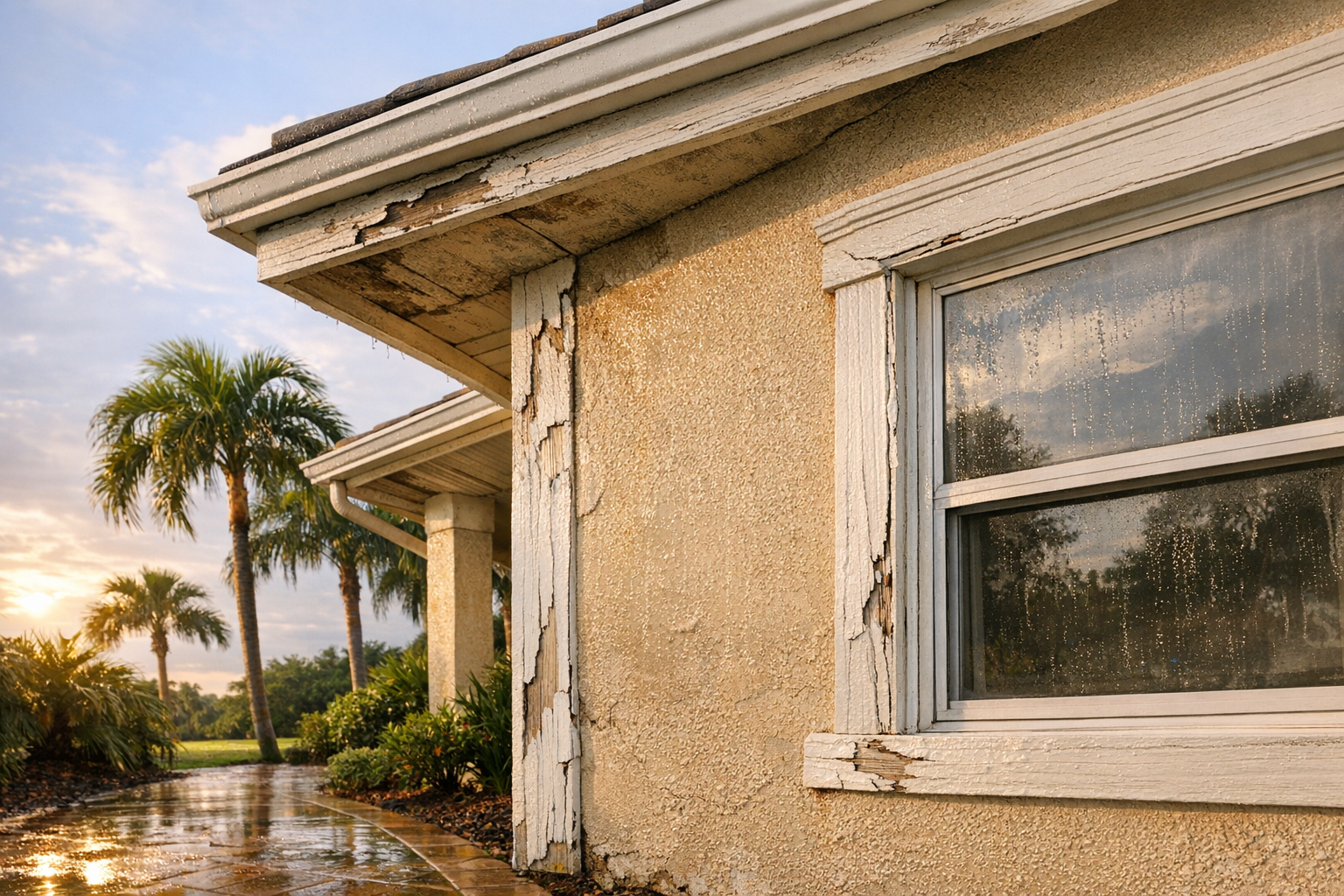
In Florida, trim failure often starts at the edges and joints, not in the middle of a board. The face may still look fine while the bottom edge of a baseboard swells, a miter opens, paint blisters near a tub, or casing feels soft beside a window. Those clues matter because trim is thin, detailed, and heavily painted, so small movement or moisture damage shows quickly.
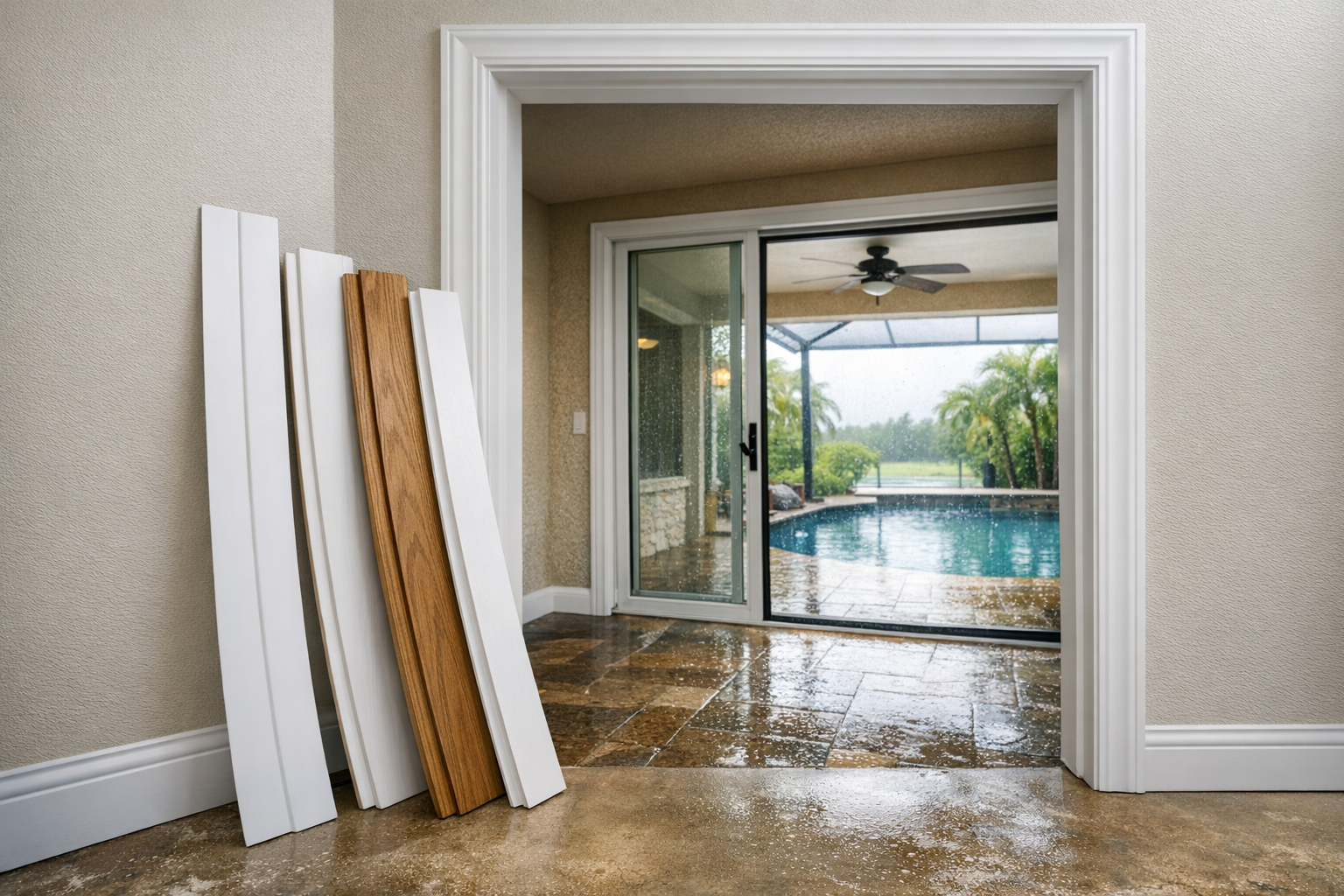
The first comparison point is moisture resistance, but that does not mean every damp condition is the same. Humid air is one level of exposure; direct water is another. A dry bedroom may only challenge interior trim materials with seasonal humidity and air-conditioning cycles. A bathroom baseboard may see steam, wet towels, splash, and cleaning water. A garage or slab-adjacent room may pick up moisture near the floor. Exterior trim has to handle rain, splashback, sun, and open joints where water can sit.
Rot resistance is different from swelling resistance. A material can avoid decay yet still move, expand, or telegraph seams. Another material may paint beautifully indoors but fail quickly if raw edges absorb water. That is why moisture resistant trim should be judged by where water can enter: cut ends, nail holes, caulk joints, bottom edges, and the back side against masonry or siding.
Expansion and contraction also deserve attention in Florida heat. Long runs of baseboard, crown, fascia, or window trim can open at joints or push against corners if the material moves more than the paint or caulk can hide. Good paint adhesion helps, but paint is not a substitute for choosing the right substrate.
For coastal homes, add salt air, wind-driven rain, and stronger UV exposure to the checklist. For exterior trim materials Florida homeowners should also weigh pest resistance and repairability: if a board dents, swells, rots, or separates, can it be patched cleanly, or does the whole run need replacement?
MDF Trim: Smooth and Affordable for Dry Paint-Grade Interiors
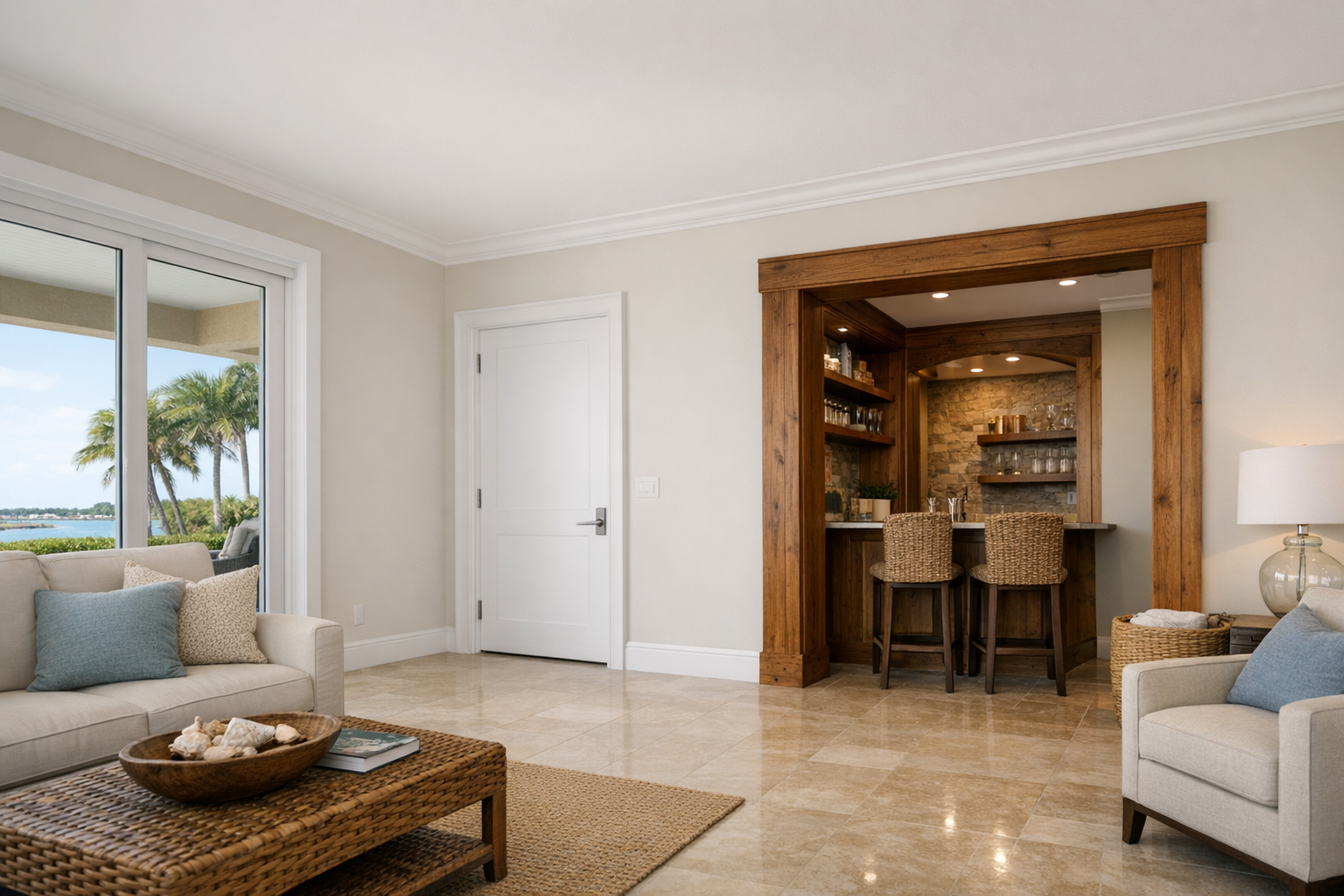
MDF earns its place when the goal is a crisp painted finish without paying for stain-grade wood. It is an engineered board made from fine wood fibers and resin, so it has a very uniform surface with no knots or grain lines fighting the paint. That makes it popular for paint-grade trim such as baseboards, door and window casing, crown molding, wainscoting parts, and built-in cabinet details in dry rooms.
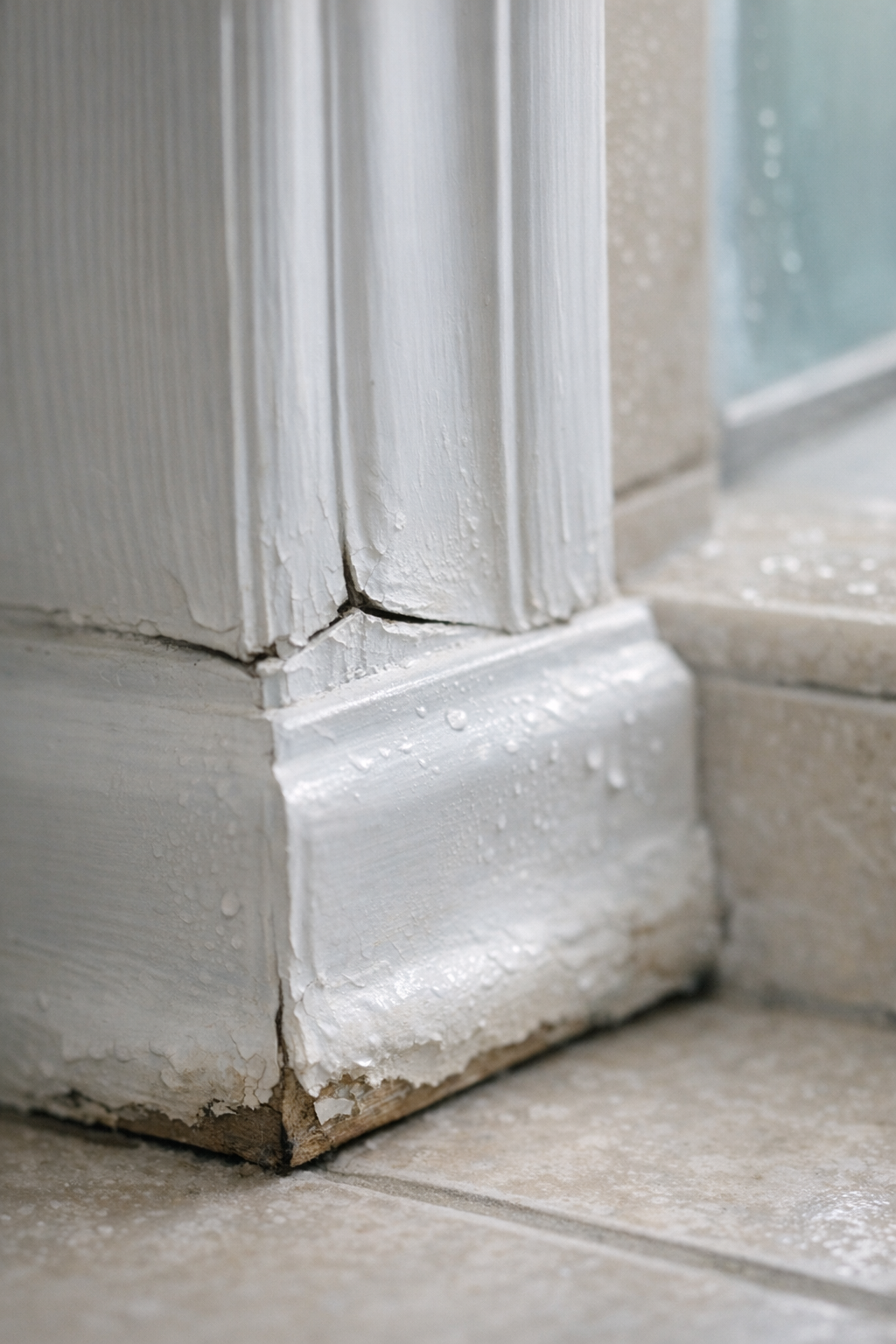
In a Florida home, standard MDF makes the most sense in air-conditioned, low-splash spaces: bedrooms, living rooms, dining rooms, hallways, closets, and upper crown profiles that are not near floors or plumbing. Compared with many wood options, it usually paints smoother and can be easier to get in consistent profiles. The tradeoff is that it is less forgiving when water reaches a raw cut, an unsealed back, a nail hole, or the bottom edge of a baseboard.
That moisture behavior is the main caution in any MDF vs wood trim Florida comparison. MDF does not simply "dry back out" like a minor surface dampness issue. Once the fibers swell at an exposed edge or cut end, the profile can puff, ripple, or lose its sharp line under the paint. It can also dent more easily than harder woods, and fasteners near edges need care because the material does not hold like solid lumber.
Moisture-resistant MDF is a step up, not a free pass for wet areas. It is made to handle incidental humidity better than standard MDF, which can help for some interior trim materials in conditioned spaces, but it is still not the right choice for exterior trim, shower-adjacent casing, splash-prone bathroom baseboards, leak-prone laundry rooms, damp garages, or slab-adjacent areas with recurring moisture. Use MDF where it can stay dry; choose another material where water is part of the room's normal life.
Wood Trim in Florida: Finger-Jointed Pine, Poplar, and Solid Wood Are Not the Same
Wood trim deserves a closer look because "wood" can mean several very different things once you start pricing baseboards, casing, crown, or custom profiles.
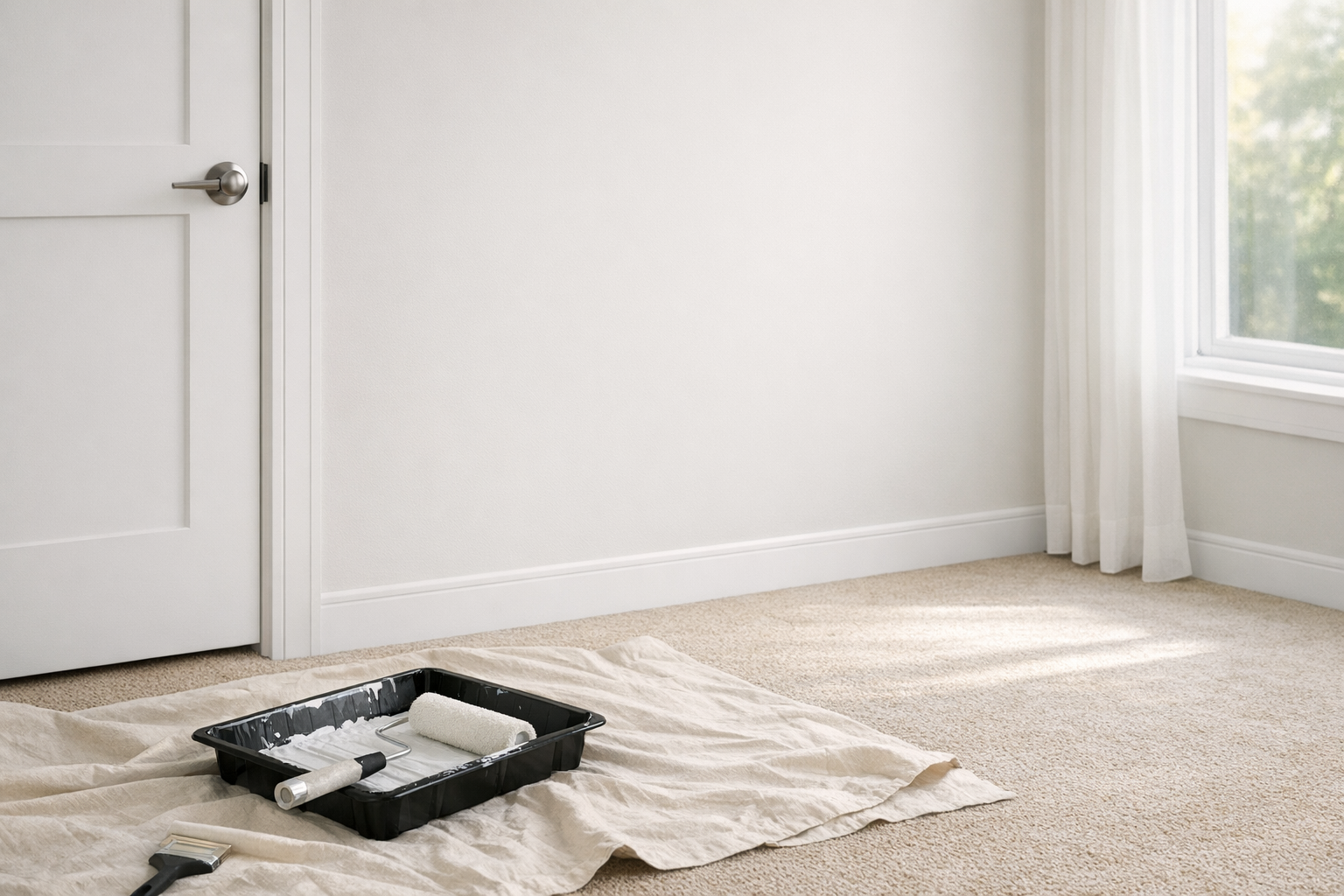
Finger-jointed pine is made from shorter pieces of pine joined end to end, then usually sold as a paint-grade trim board. Its appeal is value: you get real wood behavior and workable profiles without paying for long, clear boards. It is a sensible choice for dry interior rooms, especially for painted baseboards and door casing. The weak signal is a poor finish job: if the joints telegraph through the paint or the primer is thin at cut ends, the trim can look patched together instead of continuous. In Florida, finger-jointed pine is not the first pick for bathrooms, laundry splash zones, damp garages, or exterior trim unless the product is specifically made for that exposure.
Poplar trim is another paint-grade favorite, but it sits a step up in feel and finish. It is often chosen when homeowners want sharper profiles, smoother paint, and fewer of the knots or dents associated with cheaper pine boards. Poplar is useful for interior casing, crown, built-ins, and more detailed trim packages where MDF feels too soft or too vulnerable at the edges. The tradeoff is that poplar trim is still wood: it can absorb moisture, move with humidity changes, and show open miters or hairline cracks if the room swings between damp and dry conditions.
Solid hardwood or stain-grade wood makes sense when the trim is part of the look, not just a painted border. Oak, maple, mahogany, cypress, and other stain-grade choices are used when grain, custom profiles, historic detailing, or a traditional craftsman finish matters. These materials are usually more expensive and less forgiving of sloppy finishing because the surface stays visible. They can also be repaired, sanded, patched, or refinished more gracefully than many engineered products, which is one reason wood remains valuable in higher-end interiors.
The Florida takeaway is not that wood is wrong; it is that wood needs location-specific judgment. In conditioned living areas, properly primed and painted wood trim can be a durable, attractive upgrade over MDF. Near tubs, mop sinks, slab edges, exterior doors, and rooms with recurring moisture, every exposed cut, backside, end grain, and joint becomes more important. Wood can handle normal indoor humidity better when it is sealed on all vulnerable surfaces, but it should not be treated as a wet-area material just because it is stronger than MDF.
PVC Trim: The Strongest Choice for Wet Areas, Exteriors, and Coastal Exposure
For the spots where sealing every vulnerable wood edge feels like wishful thinking, PVC is the safer material to price. Cellular PVC is a synthetic trim board with a solid-looking surface and a lighter, foamed interior, so it is cut and shaped much like wood trim but does not behave like wood when it gets wet.
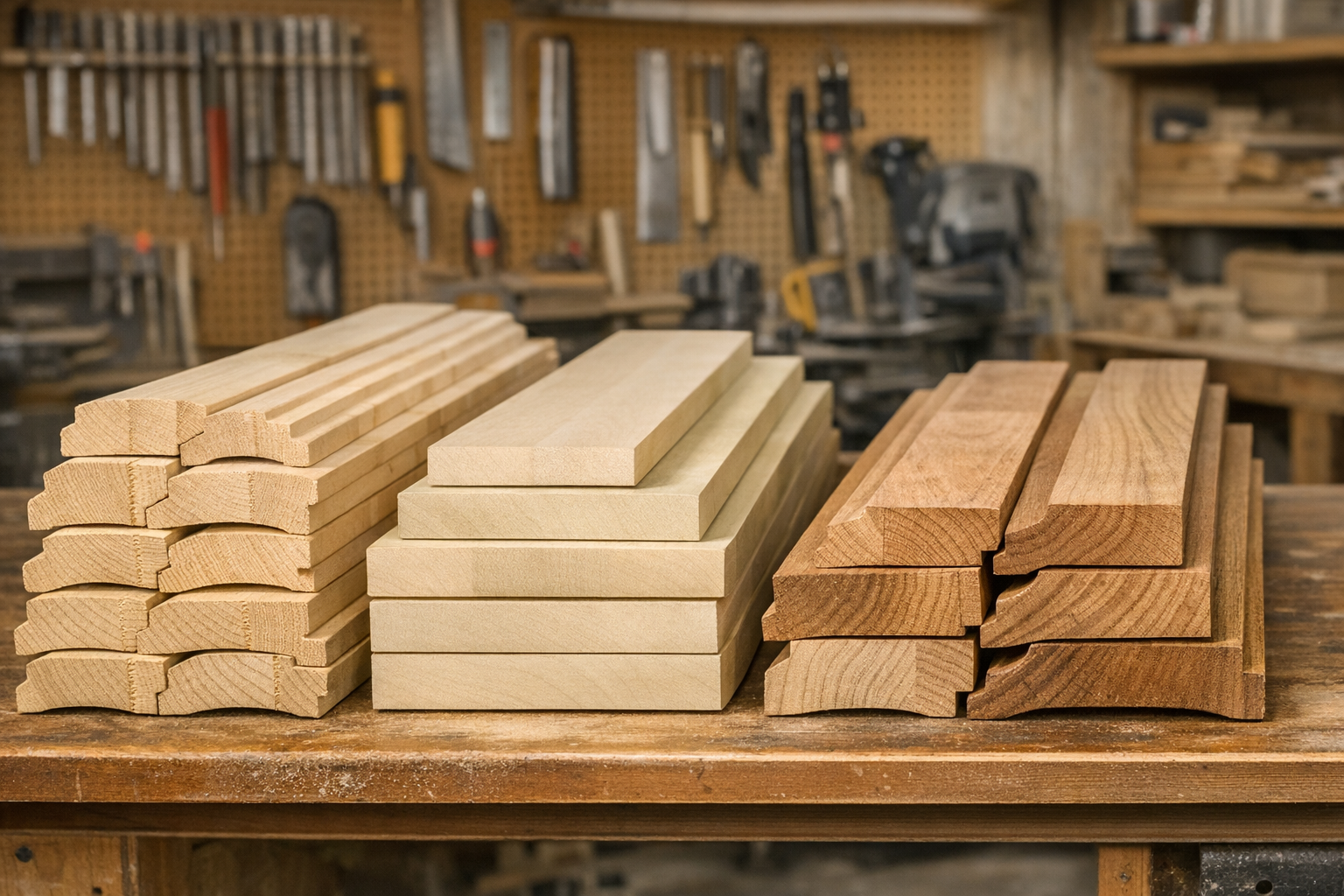
That moisture behavior is the reason PVC trim Florida projects often use it outside and in splash-prone rooms. It does not swell the way MDF can, and it is not a food source for rot or insects in the way organic trim materials can be. For a homeowner, the practical takeaway is simple: if the trim may see direct rain, repeated mopping, condensation, hose water, or salty coastal air, PVC belongs near the top of the list for moisture resistant trim.
Good uses include exterior window and door casing, fascia details, porch and lanai trim, garage openings, bathroom baseboards, laundry room baseboards, and trim near exterior doors where wind-driven rain or wet shoes are common. It is also a smart upgrade around windows that sweat from air-conditioning differences, because those lower corners are exactly where MDF and poorly sealed wood tend to show damage first.
PVC is not perfect, though. It usually costs more than MDF or common paint-grade wood, and it has a more plastic-like feel when it is cut, sanded, or fastened. Long runs can expand and contract with Florida heat, so installation details matter: joints, fasteners, adhesives, and gaps need to account for movement instead of pretending the board is dimensionally identical to wood.
Paint is another tradeoff. White or light colors are the easiest match for many cellular PVC products because darker paint can build heat in full sun and increase movement or surface stress. If you want black exterior trim, a deep bronze fascia, or another heat-absorbing color, choose the product and paint system as a pair rather than treating PVC like any ordinary primed board.
Composite Trim: Durable Middle Ground, but Product Type Matters
Composite is the category where the label can hide the most variation. Some composite trim boards are engineered wood trim made from wood fibers or strands plus binders; some are treated exterior boards with preservatives or water-resistant resins; some are fiber-reinforced or fiber-cement-style products; and some are polymer blends that behave closer to synthetic trim than to wood.
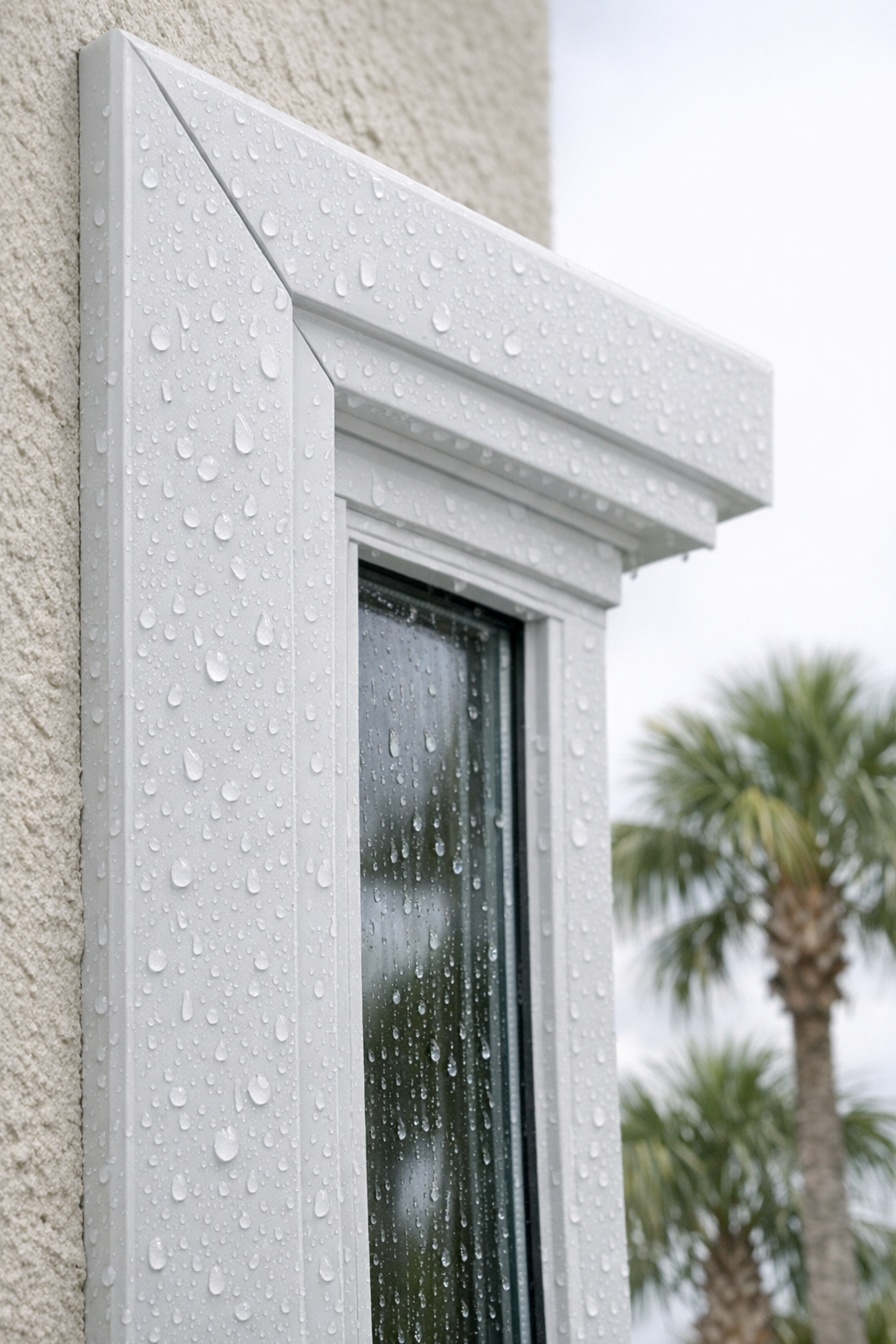
That mix matters in Florida because "composite" does not automatically mean waterproof. A treated wood-based composite may be a big improvement over ordinary pine for exterior accents or wide painted boards, but it can still have vulnerable cut ends, fastener holes, and required clearances from soil, roofs, paving, or standing water. A polymer-heavy board may resist moisture better, but it may cost more and have its own movement and paint limits. A fiber-cement-style trim can be stable and paintable, but it is heavier and more brittle to cut and handle.
Compared with MDF, most exterior-rated composites are a stronger choice anywhere humidity or occasional wetting is part of the job. Compared with natural wood, they can offer more consistent boards and less reliance on perfect sealing. Compared with PVC, many composites sit in the middle: often less expensive or more wood-like, but usually not as forgiving in constantly wet or coastal exposure.
Good candidates include painted exterior accents, larger fascia or frieze boards, garage trim, covered lanai details, and whole-house painted trim packages where PVC pricing feels too high. Weak signals include vague "moisture resistant trim" claims without an exterior rating, no stated clearance rules, no cut-end sealing instructions, or no mention of wet-location or coastal exposure. In this category, the product type is the recommendation.
Best Trim Material by Application: Interior, Bathroom, Exterior, and Coastal Areas
Here is the application-by-application shortcut I would use before picking profiles, paint colors, or upgrades.
| Location | Best fit | Use with caution | Practical takeaway |
|---|---|---|---|
| Dry bedrooms, living rooms, dining rooms, hallways, and closets | MDF, finger-jointed pine, or poplar | Solid wood if you do not need stain-grade appearance | For paint-grade interiors, MDF gives the smoothest budget finish, while finger-jointed pine and poplar add more real-wood durability. These are usually the easiest places to save money. |
| Bathrooms and powder rooms | PVC | Moisture-rated composite; painted wood away from splash zones | Baseboards near tubs, toilets, and vanities see splash, cleaning water, and condensation. PVC is the safest choice; MDF belongs only in truly low-risk, well-ventilated areas. |
| Laundry rooms, utility rooms, and garage entries | PVC or exterior-rated composite | Finger-jointed pine or poplar if the room stays dry | These rooms are leak-prone and often have wet shoes, mops, or equipment nearby. If you are debating the best baseboard material for Florida utility spaces, choose the material that can survive occasional water first. |
| Kitchens and slab-adjacent baseboards | PVC, moisture-resistant composite, or well-sealed wood | Standard MDF at floor level | Dishwasher leaks, refrigerator lines, mopping, and slab moisture make lower trim more vulnerable than upper trim. Crown or cabinet-adjacent trim can be paint-grade MDF or wood; floor-level baseboards deserve a tougher material. |
| Interior window and door casing | Poplar, finger-jointed pine, MDF, or PVC depending on exposure | MDF around leaky windows, exterior doors, or bathroom doors | Interior casing in dry rooms can be MDF or paint-grade wood. Around exterior doors, shower-adjacent openings, and windows with condensation or past leaks, upgrade to PVC or a moisture-rated composite. |
| Exterior fascia, window trim, door trim, porch, and lanai details | PVC or exterior-rated composite | Wood only with the right species, priming, sealing, clearances, and maintenance | Exterior trim takes rain, sun, heat, mildew pressure, and insects. PVC is the most forgiving wet-location option, while composite can be a strong middle ground when the specific product is rated for the exposure. |
| Coastal homes | PVC first; high-quality exterior-rated composite second | Painted wood in exposed locations | Salt air, wind-driven rain, and UV exposure raise the stakes. The best trim material for Florida homes near the coast is usually the one with the least dependence on perfect paint film and edge sealing. |
If you want one simple rule for the best baseboard material for Florida, split the house into dry and wet zones. Use MDF, finger-jointed pine, or poplar where the floor stays dry and the room is conditioned. Use PVC or a proven moisture-resistant composite where water, slab moisture, exterior doors, or coastal exposure can reach the trim.
Cost, Paintability, and Maintenance Tradeoffs Homeowners Should Weigh
The final decision usually comes down to what you want to pay for now versus what you are willing to maintain later.
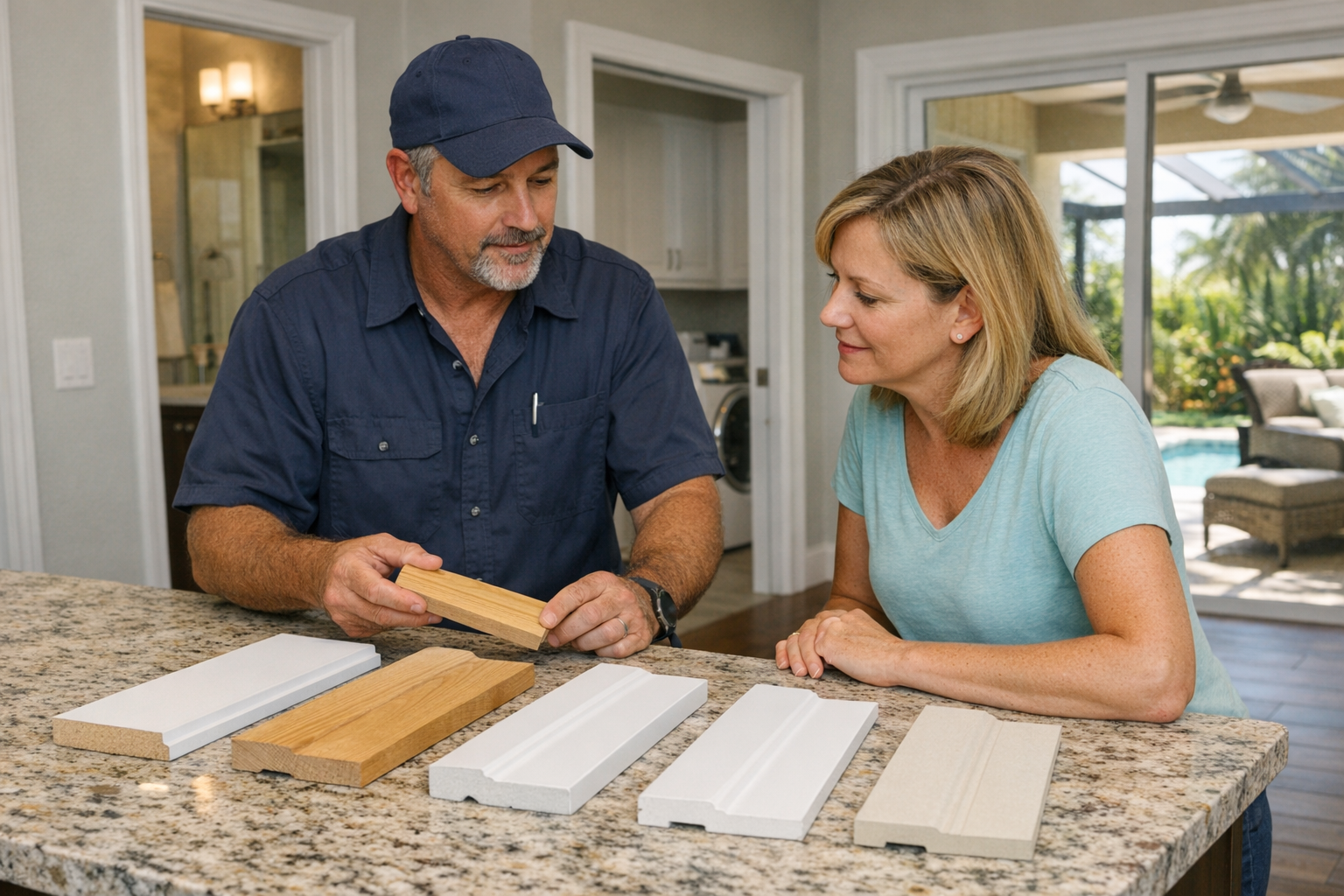
For upfront cost, MDF is usually the budget play for dry, paint-grade trim. It gives a smooth surface with minimal grain telegraphing, so baseboards and crown can look clean after paint without paying for higher-end wood. The tradeoff is damage tolerance: a swollen bottom edge or crushed corner is hard to make invisible, and replacement can erase the savings if MDF is used where water reaches it.
Finger-jointed pine and poplar sit in the middle for many interior finish carpentry materials. Pine is often economical and easy to find, but its grain and joints can show through thin paint jobs if prep is rushed. Poplar usually paints more smoothly and feels a bit more refined for door trim, casing, and built-ins, but it still needs sealed edges and normal paint maintenance. Both are easier to sand, patch, and repaint than MDF when dents are minor.
Solid wood costs more when the goal is stain-grade appearance, custom profiles, or traditional detailing. It can be repaired and refinished well, but it also asks more from the homeowner: stable indoor conditions, good paint or clear finish, and attention to joints, caulk lines, and exposed edges.
PVC tends to cost more at the start, and installation details matter because it can move with heat. In return, it reduces the risk of rot or swelling in bathrooms, laundry rooms, exterior openings, and coastal trim. Composite trim lands between categories: some products are a smart exterior value, while others behave closer to engineered wood and depend heavily on coating quality.
The practical takeaway: the best trim materials for Florida homes are not always the cheapest boards on the rack. Spend less in dry rooms if you want, but spend more where replacement, repainting, or water damage would be the real expense.